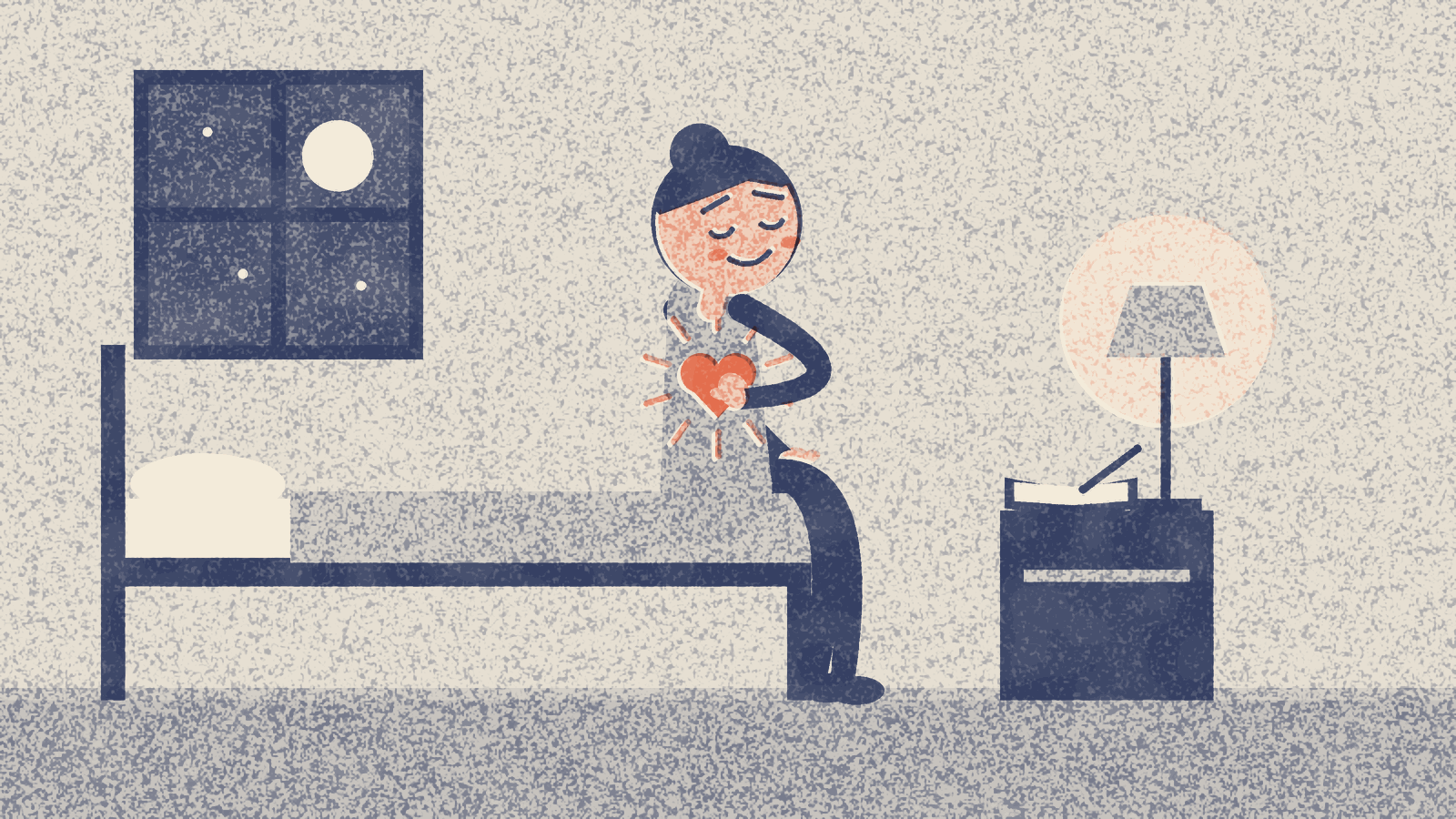
You oversleep, miss the meeting, and within seconds a voice in your head has delivered a verdict you would never say to a colleague. Most people know that voice well. Self compassion exercises give you something to do in that exact moment, and most of them take a few minutes and a pen or a hand.
Key Takeaways
- Kristin Neff’s Self-Compassion Scale (Neff, 2003) measures three paired components: self-kindness set against self-judgment, common humanity set against isolation, and mindfulness set against over-identification.
- Neff’s site Self-Compassion.org publishes a series of free written exercises, including a friend comparison, a three-part self-compassion break, supportive touch, a letter-writing practice, and a daily journal.
- In a randomized trial of 25 treatment participants and 27 waitlist participants, the eight-week Mindful Self-Compassion program produced significantly larger gains in self-compassion, mindfulness, and wellbeing than the waitlist, and the gains held at 6-month and 1-year follow-ups (Neff & Germer, 2013).
- A meta-analysis of 27 randomized trials of self-compassion interventions found moderate effects on self-compassion itself (Hedges g = 0.75), stress (g = 0.67), depression (g = 0.66), anxiety (g = 0.57), and self-criticism (g = 0.56) against control groups (Ferrari et al., 2019).
Each practice below is described the way Neff publishes it, with a link to the original. The research evidence sits in its own section, because the trials measured whole programs and the meta-analysis measured interventions as a group.
What the exercises are built to train
Neff’s definition of self-compassion has three parts. Self-kindness is warmth toward yourself when you struggle. Common humanity is the recognition that struggle belongs to every human life. Mindfulness is clear awareness of a painful feeling without amplifying it.
Nearly every exercise on her site is a way of calling up those three parts together. When a practice asks you to say “this hurts,” that is mindfulness. When it asks you to remember that other people feel this way too, that is common humanity. When it asks you to place a hand on your chest and offer a kind phrase, that is self-kindness.
Keep the three parts in mind and the exercises become easy to recognize, adapt, and remember.
Self compassion exercises start with a comparison on paper
The first exercise on Neff’s site asks you to take out a sheet of paper and answer a handful of questions (Neff, Exercise 1).
- Think of a time a close friend felt bad about themselves, and write down what you typically do and say, and the tone you use.
- Think of a time you felt bad about yourself, and write down what you typically do and say to yourself, and the tone.
- Look at both answers and ask what factors or fears lead you to treat yourself and others so differently.
- Write down how things might change if you responded to yourself the way you respond to a close friend who is suffering.
The exercise ends on an invitation to try treating yourself like a good friend and see what happens.
Seeing both tones side by side gives the other exercises a reference point, since you now have your own words for what warmth sounds like.
The self-compassion break and supportive touch
The self-compassion break is the best known of Neff’s practices (Neff, Exercise 2). You call to mind a difficult situation and notice the stress in your body. Then you say three things to yourself.
- “This is a moment of suffering.” Neff offers “This hurts,” “Ouch,” and “This is stress” as alternatives. This is the mindfulness step.
- “Suffering is a part of life.” Alternatives include “Other people feel this way,” “I’m not alone,” and “We all struggle in our lives.” This is the common humanity step.
- “May I be kind to myself.” Neff suggests asking what you need to hear right now, with phrases such as “May I give myself the compassion that I need,” “May I forgive myself,” or “May I be patient.” This is the self-kindness step, and it is paired with a hand over the heart.
The page says the practice can be used any time of day or night.
The hand over the heart has its own exercise. In supportive touch, Neff describes taking two or three deep breaths, placing a hand over your heart, and feeling its warmth and gentle pressure, then lingering as long as you like. She notes that touch can feel awkward at first and lists alternatives for anyone uneasy about the chest:
- One hand on your cheek, or cradling your face in your hands
- Gently stroking your arms
- Crossing your arms and giving a gentle squeeze
- A hand on your abdomen, or one hand on the abdomen and one over the heart
- Cupping one hand in the other in your lap
She suggests trying it several times a day for at least a week, so it can become a habit. The moment-by-moment version of this practice is explored in how to stop being so hard on yourself.
Writing a letter and keeping a journal
Two of Neff’s exercises use writing, and both give the three components a page to land on.
In exploring self-compassion through writing, you write in three parts. First you write about an imperfection that makes you feel inadequate, and the emotions it brings up. Then you imagine a friend who is unconditionally loving, who sees all your strengths and weaknesses and understands the history behind them, and you write yourself a letter from that friend’s perspective. Finally you put the letter down for a while, come back, and read it so the words can sink in.
The self-compassion journal is a daily version, suggested for one week or longer. In the evening you review the day and write down anything you felt bad about or judged yourself for. For each event you write three short pieces.
- Mindfulness: how you felt, described without belittling the feeling or dramatizing it.
- Common humanity: how the experience connects to the wider human one, including the conditions that made it harder that day.
- Self-kindness: a few words of comfort in a gentle, reassuring tone.
Neff’s own example is losing your temper with a slow server at lunch. The three paragraphs each answer a different question, and together they turn a replayed scene into something with a beginning, a middle, and a kind ending.
Working with the inner critic directly
Two further exercises address the critical voice itself. They pair well with overcoming self-criticism and with the more assertive side of the practice in fierce self-compassion.
Changing your critical self-talk is meant to be done over several weeks. Neff describes it in three steps.
- Notice when you are being self-critical, and record your inner speech as accurately as you can: the actual words, the recurring phrases, the tone, and whether the voice reminds you of anyone.
- Soften the critical voice with compassion, for example by acknowledging its worry and asking whether your compassionate self can say a few words.
- Reframe what the critic said in a friendly, constructive way, imagining what a very compassionate friend would say.
Identifying what we really want takes aim at the habit of using self-criticism as a motivator. You pick a trait you criticize yourself for, get in touch with the pain the criticism causes, and give yourself compassion for it. Then you look for a kinder way to encourage change, using the language a wise and nurturing friend, parent, teacher, or mentor would use. Neff closes the exercise with the line that if you really want to motivate yourself, love is more powerful than fear.
Breines and Chen (2012) reported that self-compassion increased self-improvement motivation.
What the trials measured
The strongest evidence for self-compassion training comes from programs and from pooled trials, and it describes what those measured.
Neff and Germer’s 2013 study evaluated the Mindful Self-Compassion program, an eight-week workshop designed to train people to be more self-compassionate. The pilot study followed 21 community adults, and the randomized trial compared a treatment group of 25 with a waitlist group of 27. The treatment group reported significantly larger increases in self-compassion, mindfulness, and wellbeing, and the gains held at 6-month and 1-year follow-ups (Neff & Germer, 2013).
That result describes the program as a whole: what an eight-week course produced in a group of community adults.
The pooled picture comes from Ferrari and colleagues (2019), who combined 27 randomized trials of self-compassion interventions. Participants improved on self-compassion (g = 0.75), stress (g = 0.67), depression (g = 0.66), anxiety (g = 0.57), and self-criticism (g = 0.56), each against a control group. Our page on self-compassion statistics lays out the numbers in more detail.
How the Self-Compassion Scale describes what you are practicing
Neff built the Self-Compassion Scale and described its development and validation in 2003. It is a questionnaire that measures the three components as pairs: self-kindness and self-judgment, common humanity and isolation, mindfulness and over-identification.
The scale’s own documentation states that there are no clinical norms or scores which indicate that an individual is high or low in self-compassion (Neff, Self-Compassion Scale information). Researchers mainly use it to compare outcomes for people who score higher or lower. A score on a questionnaire gives you a description of your own tendencies on one day, and the exercises above give you something to do with them.
Starting small
Neff’s pages suggest a modest rhythm. The journal runs for a week. Supportive touch is suggested several times a day for at least a week. The critical self-talk exercise unfolds over several weeks.
One way to combine them into a first week:
- Day one: write the friend comparison and keep both answers.
- Days two through seven: run the three sentences of the self-compassion break once a day, with a hand on your chest.
- Each evening: write one journal entry on the day’s hardest moment, in three short pieces.
At the end of the week, reread the comparison from day one. The tone you use with a friend and the tone you use with yourself may sit closer together than they did.
A voice that learns new sentences
The critical voice has had years of practice, and it speaks fluently. The exercises offer it a few other sentences to try: this hurts, other people feel this too, may I be kind to myself.
With repetition, those sentences become familiar. A hand on the chest, three short phrases, and a pause where the verdict used to arrive.
Related reading
- Compassion Fatigue and Self-Care
- Self-Compassion vs Self-Esteem: What Helps
- Examples of Negative Self-Talk
References
Breines, J. G., & Chen, S. (2012). Self-compassion increases self-improvement motivation. Personality and Social Psychology Bulletin, 38(9), 1133-1143.
Ferrari, M., Hunt, C., Harrysunker, A., Abbott, M. J., Beath, A. P., & Einstein, D. A. (2019). Self-compassion interventions and psychosocial outcomes: A meta-analysis of RCTs. Mindfulness, 10(8), 1455-1473.
Neff, K. D. (n.d.). Exercise 1: How would you treat a friend? Self-Compassion.org.
Neff, K. D. (n.d.). Exercise 2: Self-compassion break. Self-Compassion.org.
Neff, K. D. (n.d.). Exercise 3: Exploring self-compassion through writing. Self-Compassion.org.
Neff, K. D. (n.d.). Exercise 4: Supportive touch. Self-Compassion.org.
Neff, K. D. (n.d.). Exercise 5: Changing your critical self-talk. Self-Compassion.org.
Neff, K. D. (n.d.). Exercise 6: Self-compassion journal. Self-Compassion.org.
Neff, K. D. (n.d.). Exercise 7: Identifying what we really want. Self-Compassion.org.
Neff, K. D. (n.d.). Self-Compassion Scale (SCS) information and scoring. Self-Compassion.org.
Neff, K. D. (2003). The development and validation of a scale to measure self-compassion. Self and Identity, 2(3), 223-250.
Neff, K. D., & Germer, C. K. (2013). A pilot study and randomized controlled trial of the mindful self-compassion program. Journal of Clinical Psychology, 69(1), 28-44.