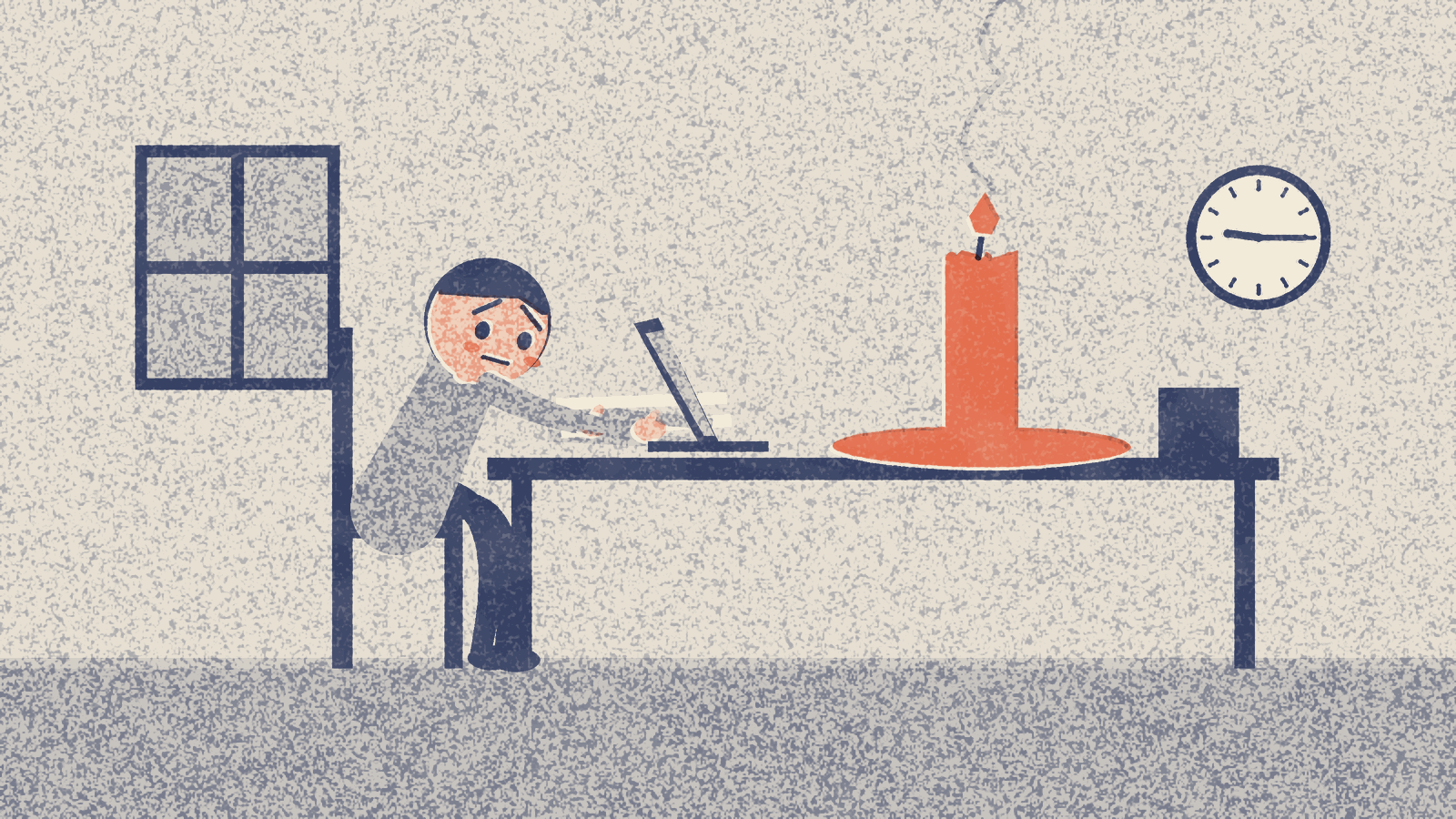
You get to the end of a Sunday and feel a small dread about Monday that has grown a little each week. The work still gets done, but something underneath it has gone flat, and a tired night’s sleep no longer touches it. Burnout symptoms often arrive this quietly, which is why so many people explain them away for months.
Key Takeaways
- Maslach and Leiter (2016) describe burnout through three dimensions: exhaustion, cynicism or detachment from the job, and a sense of ineffectiveness.
- The World Health Organization’s ICD-11 describes burn-out as a syndrome resulting from chronic workplace stress that has not been successfully managed, and lists it as an occupational phenomenon.
- The WHO states that burn-out refers to the occupational context and should not be applied to experiences in other areas of life.
- Researchers disagree about how far burnout can be separated from depression: Maslach and Leiter (2016) call burnout job-related and situation-specific, while Bianchi, Schonfeld and Laurent (2015) argue it is a form of depression.
- Maslach and Leiter (2016) name six areas of worklife where a mismatch between person and job raises risk: workload, control, reward, community, fairness and values.
What burnout symptoms actually are
The most widely used account comes from Christina Maslach, whose research tradition defines burnout as a psychological syndrome that emerges as a prolonged response to chronic interpersonal stressors on the job (Maslach & Leiter, 2016). The key word is chronic. A bad quarter or a brutal deadline week can leave you drained, and burnout names what happens when the strain keeps going and recovery never arrives.
The same paper organizes burnout symptoms into three dimensions. Each one has its own texture, and together they give the term its meaning.
The World Health Organization uses the same three-part structure in ICD-11, where burn-out is described as a syndrome resulting from chronic workplace stress that has not been successfully managed.
Exhaustion: the signal people notice first
Exhaustion is the dimension most people recognize in themselves. Maslach and Leiter (2016) describe it as an overwhelming exhaustion, and the vocabulary around it includes wearing out, loss of energy, depletion and fatigue. The WHO phrases it as feelings of energy depletion or exhaustion.
In daily life it can look like this:
- Waking up already tired, even after a full night in bed
- Needing a long recovery period after tasks that used to feel ordinary
- Running on caffeine and adrenaline until a weekend arrives, then collapsing through it
- Feeling that your emotional reserves are gone, so small requests land as large demands
Exhaustion is easy to see and easy to excuse, because everyone gets tired. Maslach and Leiter (2016) argue that exhaustion by itself is a thin definition. If burnout were only exhaustion, they write, the word burnout would be unnecessary. The other two dimensions give burnout its shape.
Cynicism: when the job starts to feel pointless
The second dimension was originally called depersonalization and is now more often called cynicism. Maslach and Leiter (2016) describe it as feelings of cynicism and detachment from the job, and earlier descriptions of the dimension include irritability, loss of idealism and withdrawal. The WHO describes it as increased mental distance from one’s job, or feelings of negativism or cynicism related to one’s job.
This is the symptom that reaches into meaning. Work that once carried some significance starts to feel like a string of tasks you perform at a distance.
Common signs include:
- Dreading messages from colleagues you used to like
- A dry, sarcastic tone about your own field or organization
- Doing the minimum and watching the clock
- Losing the sense that any of it matters to anyone
Maslach and Leiter (2016) point to evidence that cynicism may be the most central of the three. In the profile research they describe, a cynicism-only profile came closer to full burnout than an exhaustion-only profile, and cynicism was the dimension most predictive of turnover. They present this as a newer approach, and it comes from their own framework and a cited profile study, so it is best held as a promising finding.
If this dimension sounds familiar, the question of what work is for sits close by. The piece on work and the meaning of life follows that thread.
Reduced efficacy: the quiet loss of confidence
The third dimension began as reduced personal accomplishment. Maslach and Leiter (2016) describe it as a sense of ineffectiveness and lack of accomplishment, and later versions of the measure call it professional efficacy. The WHO lists it as reduced professional efficacy.
It tends to show up as a private story about yourself:
- Tasks take longer, and the results feel mediocre
- You doubt whether you were ever good at this
- Small errors feel like proof of a bigger decline
- Nothing you finish gives you the lift it used to
In this framework it is one part of a pattern that develops inside a work environment, and it can be the hardest dimension to spot because it feels like a private verdict on you.
Burnout symptoms and depression: a debated line
Many of these experiences overlap with low mood, and researchers disagree about where the line sits.
Maslach and Leiter (2016) describe burnout as job-related and situation-specific, and depression as more general and context-free. They also cite a longitudinal Finnish study finding a reciprocal relationship between the two. They criticize a 2016 study that reported the two as indistinguishable at high levels, on the grounds that its measures overlapped heavily in their focus on fatigue.
Bianchi, Schonfeld and Laurent (2015) take a different position in a perspective article in Frontiers in Public Health. Their abstract concludes that the current state of science suggests burnout is a form of depression, and they suggest public health efforts should address its depressive core.
Both camps are published researchers reading the same literature. For a reader, the practical takeaway is modest. Low mood, loss of pleasure and hopelessness that reach beyond the job deserve attention in their own right. If your symptoms follow you home and into everything, please reach out to a doctor or licensed mental health professional.
How the WHO classifies burn-out
ICD-11 lists burn-out as an occupational phenomenon, and the WHO states that it is not classified as a medical condition in its own right. It appears in a chapter for factors influencing health status or contact with health services. The WHO also states that burn-out refers specifically to the occupational context and should not be applied to describe experiences in other areas of life.
That scoping gives burnout symptoms a specific home: the relationship between a person and a job. It also explains why the research looks at the workplace as well as the individual.
Where burnout symptoms come from
Maslach and Leiter (2016) name six areas of worklife where a mismatch between person and job can build up:
- Workload: chronic overload that leaves little time to recover
- Control: little influence over decisions and resources
- Reward: too little recognition, whether financial, institutional or social
- Community: poor support, weak trust and unresolved conflict
- Fairness: perceived unfair decisions or treatment
- Values: a gap between your values and the organization’s
The authors note that most research on burnout has used cross-sectional designs or statistical causal models, and that many of the variables have been measured by self-report. As a map, though, the six areas give you questions to ask about a job: where is the mismatch widest right now?
This is also where the numbers come in. How many people report these symptoms depends heavily on how a survey counts burnout, and how common burnout is lays out what each survey measured. The related question of how many workers are stressed covers the stress that sits upstream.
Sitting with what you notice
A list of symptoms works best as a mirror. You might read through the three dimensions and notice that one of them has been present for a long time, quietly, while you kept telling yourself it was just a busy season.
Burnout symptoms ask a question about the fit between you and the work you do every day. That question can feel heavy when you are depleted, and it can also be the beginning of a different relationship with your working life. If the question grows larger than your current job, feeling lost in your career is a place to keep thinking it through.
Notice which dimension speaks loudest in you this week. That one is worth listening to.
Related reading
- How Many People Hate Their Job? What Each Survey Actually Asked
- 15 Questions to Discover Your Life Purpose, Sorted Into Five Angles
- Autopilot Living: What Going Through the Motions Reveals About Your Attention
Related reading: How Many Times Do People Check Their Phone a Day? What Logged Studies Show, How to Start Over in Life When the Old One Stops Working and No Purpose in Life: What to Do When Meaning Has Disappeared.
References
Bianchi, R., Schonfeld, I. S., & Laurent, E. (2015). Is it time to consider the “burnout syndrome” a distinct illness? Frontiers in Public Health, 3, Article 158.
Maslach, C., & Leiter, M. P. (2016). Understanding the burnout experience: Recent research and its implications for psychiatry. World Psychiatry, 15(2), 103-111.
World Health Organization. (2019, May 28). Burn-out an “occupational phenomenon”: International Classification of Diseases.