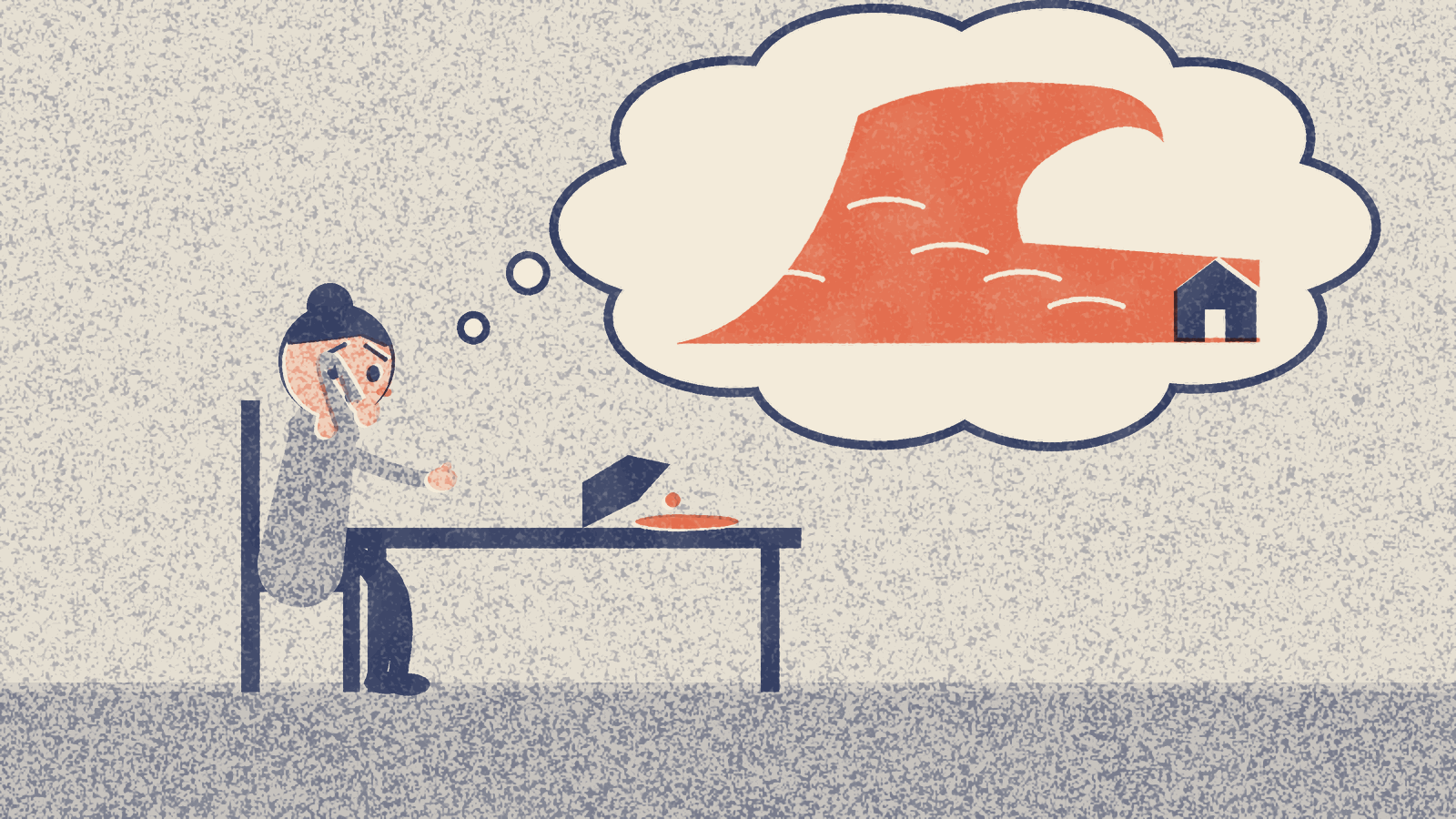
Your manager writes, “Can we talk tomorrow?” Within a minute you have moved through a performance review, a layoff, a missed mortgage payment and a quiet apartment with a box of your things. The message was seven words long.
That sprint from a small, ambiguous event to the worst possible ending is catastrophizing. Most people recognize it the moment it is named, because the mind does it so fluently that it feels like perception. This article looks at how catastrophizing works, what researchers have found about it, and what happens when the disaster is walked all the way down.
Key Takeaways
- Catastrophizing is the habit of treating an uncertain event as the start of a disaster, usually through a fast chain of what-if thoughts.
- Gellatly and Beck (2016) reviewed the literature on catastrophic beliefs as a predictor and correlate of psychological disorders and concluded that the process of catastrophic thinking is transdiagnostic, while its content is unique to each disorder (Gellatly & Beck, 2016).
- The Pain Catastrophizing Scale, a 13-item self-report measure published in 1995, describes catastrophizing through three components: magnification, rumination and helplessness (Sullivan et al., 1995).
- In a 2020 study of 29 undergraduates who met criteria for generalized anxiety disorder on a self-report questionnaire, 91.4 percent of recorded worry predictions did not come true (LaFreniere & Newman, 2020).
- Walking a feared outcome forward into its specific consequences gives the thought a size, a timeline and a next step.
What catastrophizing is
Catastrophizing is the mental move of taking an uncertain situation and treating its worst version as the likely one. A headache becomes a tumor. A pause in a conversation becomes the end of a friendship. A rejected proposal becomes proof that the whole career was a mistake.
The word has a long history in psychotherapy. Gellatly and Beck (2016) credit Albert Ellis with the original description of catastrophizing, and their 2016 paper in Cognitive Therapy and Research examines it as a process shared across psychiatric disorders.
In everyday life the pattern has two parts. One part is magnification, where the possible damage grows larger with each repetition. The other part is momentum, where each imagined consequence summons the next one without any new information arriving.
How the leap from “uncertain” to “ruined” happens
Uncertainty is uncomfortable, and the mind tends to resolve discomfort by producing a story. A catastrophe is a very complete story. It has a clear ending, and a clear ending feels more bearable than an open question for a few seconds, even when the ending is terrible.
Then the chain runs. Each link usually starts with “what if”:
- What if the meeting is about my work?
- What if my work has been slipping?
- What if they have already decided?
- What if I cannot find another job?
Notice how the grammar changes along the way. The first sentence is a question about a meeting. The last one is a statement about your future, delivered with the confidence of something already known.
This is the same acceleration described in how to stop spiraling thoughts, where thinking climbs from events to meanings about the self. Catastrophizing is one of the most common engines behind that climb, because the feared outcome is always worse than the one before it.
What the research says about catastrophizing
Researchers have studied catastrophizing from several angles, and three findings are worth holding onto.
A shared process with different content
Gellatly and Beck (2016) reviewed the literature on catastrophic beliefs as a predictor and correlate of psychopathological disorders. Their conclusion is that the process of catastrophic thinking is transdiagnostic, which means it shows up across many different diagnoses, while the content is unique to each one (Gellatly & Beck, 2016).
A person with panic fears the heartbeat means a heart attack. A person with health anxiety fears the lump means cancer. A person with social anxiety fears the stumble means permanent humiliation. The scenes differ and the engine is the same. The authors also propose a model of the catastrophic cycle and offer recommendations for prevention and psychotherapy.
Three components in one scale
In 1995, Sullivan, Bishop and Pivik published the Pain Catastrophizing Scale, a 13-item self-report measure built to capture catastrophizing in response to pain (Sullivan et al., 1995). Its items are commonly grouped into three components:
- Magnification: wondering whether something serious may happen.
- Rumination: repeatedly thinking about the problem.
- Helplessness: the sense that nothing can be done about it.
The same three components show up in ordinary worry. The threat looks bigger, the mind keeps circling it, and your own power to act looks smaller.
What the worst case tends to do
Fear predicts that disaster is likely. A 2020 study in Behavior Therapy followed 29 undergraduates who met criteria for generalized anxiety disorder on a self-report questionnaire. Participants recorded their worries and later recorded what happened, with outcomes tracked over 30 days. Of the worries they recorded, 91.4 percent did not come true (LaFreniere & Newman, 2020).
The same study asked participants how likely they judged each worry to be. Their average emotional probability was 62.09 percent and their average logical probability was 41.67 percent, against an actual average of 8.6 percent. The sample was small and young, so the numbers describe that group. The full breakdown of what the study counted is in what percentage of worries come true.
What catastrophizing feels like in a body
Catastrophic thoughts rarely stay in the head. The chest tightens, the stomach drops, breathing goes shallow. The body responds to the imagined disaster as if it were present, which adds fresh evidence for the mind: I feel terrible, so something must be terribly wrong.
Common signs include:
- Checking and rechecking a phone, an inbox or a symptom.
- Rehearsing conversations that have not happened yet.
- Asking others for reassurance and feeling relief that lasts minutes.
- Treating every uncertainty as a problem that must be solved tonight.
Any one of these is ordinary. Together they form a loop, and the loop keeps the disaster feeling close.
Walking the catastrophe to its end
A catastrophic thought usually stops at its most frightening image. The mind produces the disaster, holds it up, and never follows it into the days afterward. Following it is a technique sometimes called decatastrophizing, and it can be done in a few minutes with a page of paper.
Here is one way to run it:
- Name the feared event in one sentence. “I lose my job.”
- Ask what the likely version looks like. A tense meeting, a request for a deadline change, a routine check-in.
- Walk the worst version forward week by week. What would you do in the first week? Who would you call? What would the second month hold?
- Write the next concrete step. One action that belongs to you this week, however small.
Followed step by step, the catastrophe can resolve into a difficult stretch with edges. A difficult stretch has a size and an end, and a size is something the mind can plan around.
This is the territory of the page on what your worst-case scenario really is, where the worst case gets examined at its true weight.
Where catastrophizing sits among anxious thinking
Catastrophizing, rumination and worry overlap, and many people live with all three. If you want a map of how they differ, rumination vs overthinking lays out the loops side by side. If you wonder whether your thinking pattern is a form of anxiety, is overthinking anxiety goes into it.
Catastrophic thinking appears across many psychiatric disorders, according to Gellatly and Beck (2016). When catastrophic thoughts are frequent, intense, or keep you from sleeping, working or living, a mental health professional is the right person to look at the whole picture with you, and reaching out to one is an act of care for yourself.
Sitting with the unfinished sentence
Every catastrophe is an unfinished sentence. It begins with “what if” and ends in a dark image before the sentence has a chance to land anywhere real.
Next time the chain starts, you might notice where it stops. See if you can write the next three lines past the worst moment. Most of life sits in those lines, and most of the people you love are in them too.
Related reading
- How to Stop Overthinking
- Signs of Overthinking
- How Many People Actually Have Anxiety? Statistics Explained
Related reading: What Percentage of People Go to Therapy? Survey Numbers by Country, What Percentage of People Have an Inner Monologue? What the Research Measured and What Percentage of People Meditate? What the Surveys Counted.
References
Gellatly, R., & Beck, A. T. (2016). Catastrophic thinking: A transdiagnostic process across psychiatric disorders. Cognitive Therapy and Research, 40(4), 441-452.
LaFreniere, L. S., & Newman, M. G. (2020). Exposing worry’s deceit: Percentage of untrue worries in generalized anxiety disorder treatment. Behavior Therapy, 51(3), 413-423.
Sullivan, M. J. L., Bishop, S. R., & Pivik, J. (1995). The Pain Catastrophizing Scale: Development and validation. Psychological Assessment, 7(4), 524-532.