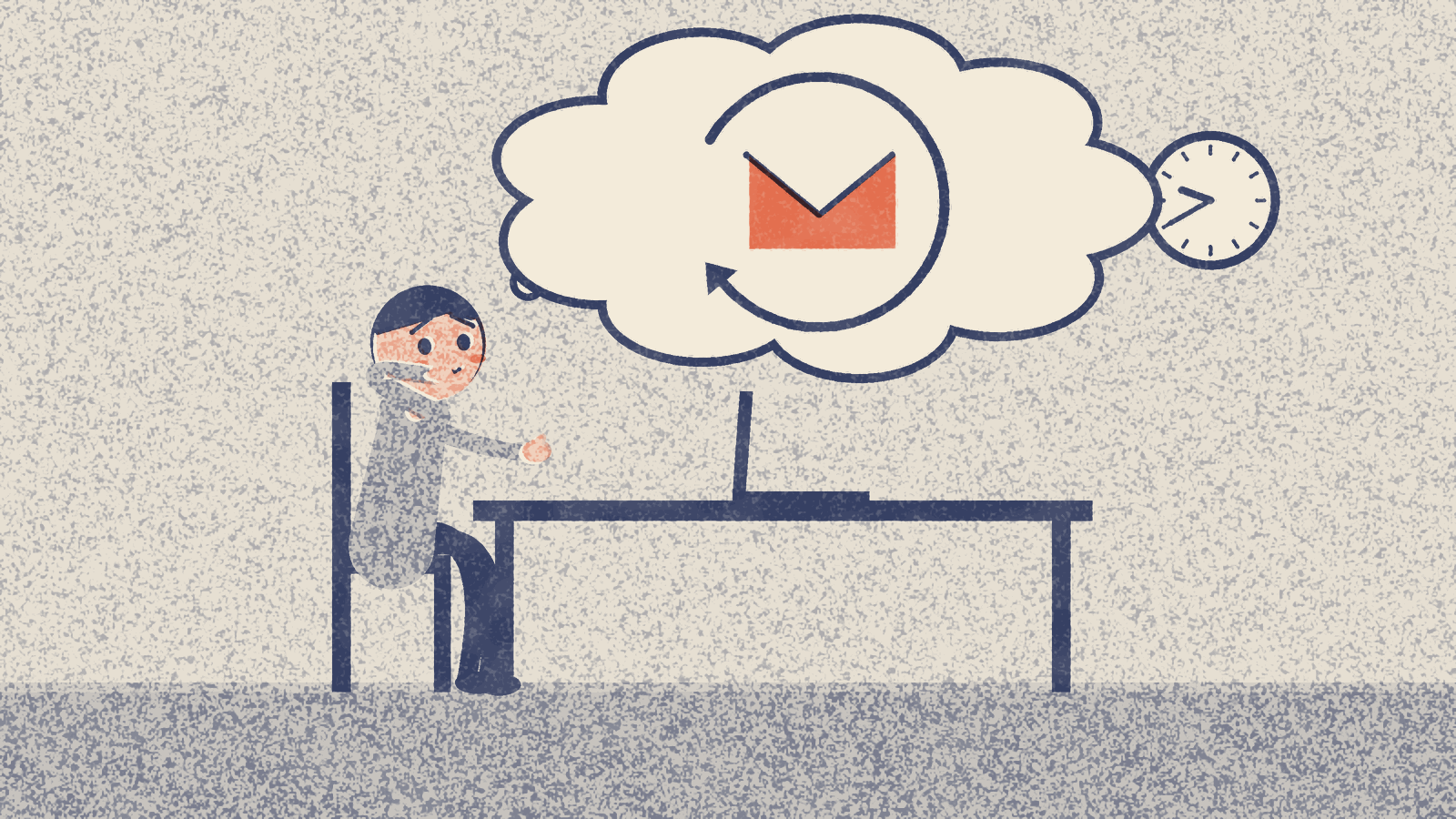
You send the email at 4:40 and close the laptop. By 5:15 you are in the kitchen composing a second email in your head, one that softens the tone of the first. By nine you have reread the first one four times from memory, and the word “per” in the second sentence has started to look like an accusation. This is overthinking at work: a mind that keeps processing a task, a meeting or a comment long after the working day has handed it back.
The pattern is common enough to have its own research literature, and that literature draws a useful line through it. Some of what your mind does after hours is planning. Some of it is a loop with no exit. Learning to tell them apart changes what you do next.
Key Takeaways
- Two forms of work-related rumination stand out: affective rumination, which replays how work felt, and problem-solving pondering, which works toward a next step (Querstret & Cropley, 2012).
- In a survey of 719 adult workers, affective rumination was the strongest predictor of both chronic and acute work-related fatigue, and problem-solving pondering predicted lower fatigue (Querstret & Cropley, 2012).
- Psychological detachment from work, the ability to mentally switch off, is one of four recovery experiences that researchers can measure separately (Sonnentag & Fritz, 2007).
- Repetitive thought can have constructive or unconstructive consequences, and one factor that shapes which way it goes is whether the thinking is abstract or concrete (Watkins, 2008).
- In laboratory studies, unfinished goals caused intrusive thoughts, and formulating a specific plan for the goal eliminated that interference (Masicampo & Baumeister, 2011).
Many of the people who search for how to stop overthinking at work are asking the same underlying question: why does my mind keep going when the day is over? The sections below take that question apart one situation at a time.
Two kinds of thinking that look identical from the inside
Researchers who study work-related rumination separate it into pieces. Querstret and Cropley (2012) measured three of them: affective rumination, problem-solving pondering and detachment.
Affective rumination is the emotional replay. It sounds like “why did I say that in the meeting” and “she seemed annoyed.” Problem-solving pondering is the working-through. It sounds like “I need to confirm the deadline with the client tomorrow.”
Both feel like thinking hard about work, so from inside your own head they can pass for each other. The consequences differ, though. In the 719 workers surveyed, affective rumination was the strongest predictor of higher chronic and acute fatigue, while problem-solving pondering predicted lower fatigue. Sleep quality partly accounted for both links. The authors conclude that the type of work-related rumination is the key factor in recovery from work.
A quick sorting question helps: does this thought end in an action I can take, or does it end in a feeling? A thought that ends in “so I will ask for the brief on Monday” belongs to the first kind. A thought that ends in “I always get this wrong” belongs to the second.
Why do I overthink everything at work?
Work hands the mind an unusually rich supply of material for loops. Several features of an ordinary job line up with what researchers describe as the conditions for repetitive thought.
- Ambiguity. A short email from a manager, a calendar invite with no agenda, a “let’s talk tomorrow.” Each one is a blank that the mind fills with the worst available story.
- Evaluation. Your work is judged, sometimes formally and often silently, so each interaction can read as a small verdict.
- Open loops. Projects rarely finish cleanly at 5 p.m., and unfinished tasks keep asking for attention.
- Stakes that touch identity. Income, reputation and a sense of competence all ride on the same few conversations.
Watkins (2008) reviewed the research on repetitive thought and identified several factors that shape whether it helps or harms, including the context in which it occurs and the level of construal, meaning whether the thinking is abstract or concrete. Work supplies plenty of context that invites abstract questions such as “what does this say about me” and fewer prompts for concrete ones such as “what is the next step.”
If you recognize this shape from other parts of your life, the page on rumination vs overthinking lays out where each loop sits among the others. At work the same machinery simply has more triggers.
The email, the meeting and the feedback replay
Three work moments account for most of the loops people describe.
After you send something. The email goes out and the mind runs a second round of review, hunting for the tone error, the missing attachment, the sentence that could be misread. Once the message is sent, the review cannot change it, so this loop produces worry without producing improvement.
After a meeting. You replay what you said, how you phrased it, who looked at whom. The replay of conversations has its own psychology, and the workplace version usually adds a status layer: you are also replaying how you appeared to the people who influence your career.
After feedback. Praise slides off and a single qualifier sticks. A review that says nine good things and one “could be more proactive” tends to leave the one in residence for days.
All three follow the affective pattern. They revisit a feeling about an event that has already happened. The research on rumination by Nolen-Hoeksema, Wisco and Lyubomirsky (2008) reviews evidence that this kind of repetitive focus on distress enhances negative thinking and impairs problem solving. A closed event offers no new information to analyze, so the extra rounds have little to work with.
Decisions that will not close
Decisions at work carry a different flavor of overthinking. Which vendor, which candidate, whether to speak up, whether to apply for the role. The mind compares, reverses, compares again.
This loop often mixes both kinds of thought. Some of it is real problem-solving, because the decision matters and information is missing. Some of it is the feeling of risk wearing the costume of analysis.
A useful test is whether new information entered the loop in the last hour. If it did, you are deciding. If the same three considerations have rotated for the third evening, you are circling. The practical move is to set a decision date and a short list of what you would still need to learn by then.
Switching off: what detachment means and why the evening matters
Sonnentag and Fritz (2007) developed a short questionnaire that measures four ways people recover from work during their free time: psychological detachment, relaxation, mastery experiences and control. Across samples totaling 930 people, they showed that these four can be told apart statistically, and in a subsample of 271 they found moderate relations between the recovery experiences and measures of job stressors and well-being.
Psychological detachment in their framework is the mental piece. You are at the dinner table and your attention is at the dinner table. That ordinary-sounding state is a recovery process with its own measurement scale, which says something about how much weight researchers give it.
Overthinking at work eats exactly this. The body leaves the office and the mind stays in the open-plan room. The Sunday-evening version has its own numbers, which the Sunday scaries page walks through survey by survey.
What reduces overthinking at work
The research points to a handful of moves that fit a working day. Each one gives the mind something concrete to do with the material it is already chewing.
- Write the plan before you leave. Masicampo and Baumeister (2011) found that unfinished goals caused intrusive thoughts and that letting participants formulate a specific plan for those goals eliminated the interference. A five-minute end-of-day note listing what is open and the first action for each gives the unfinished work a place to live other than your head.
- Convert the feeling into a next step. When a replay starts, ask what concrete action the thought is pointing at. If there is one, put it in the note. If there is none, you have identified the loop. This applies Watkins’s observation about concrete versus abstract processing in a practical way.
- Mark a hard stop for review. Decide in advance that an email gets one read before sending and none after. Closed events deserve closed review.
- Build a transition ritual. A walk, a change of clothes, a specific playlist. Detachment is easier to reach when something marks the boundary between the two states.
- Move the worry to a scheduled slot. If the mind insists on reviewing the day, give it ten minutes at a set time with a pen in hand, and end the session when the timer does.
For the general toolkit beyond the workplace, how to stop overthinking is the broader page.
When it follows you into the night
If work loops regularly cost you sleep, sleep quality is part of the picture, since it partly accounted for the link between rumination and fatigue in the Querstret and Cropley survey. The page on overthinking at night covers that stretch of the day.
If sleep, appetite or health have been affected for weeks, it is worth talking with a doctor or a licensed therapist. Persistent loops that interfere with daily life deserve that kind of attention, and it is a reasonable thing to ask for.
A quieter way to hold the job
Most of the thinking you do about work comes from caring about it. That care is worth keeping, and the loops are what it sounds like when the care has nowhere useful to go.
Perhaps the question to carry into tomorrow is a small one. When the replay begins, what is this thought pointing at: something I can do, or something I feel? Asking it takes a few seconds, and the answer tells you which kind of thinking you are in the middle of.
Related reading
References
Masicampo, E. J., & Baumeister, R. F. (2011). Consider it done! Plan making can eliminate the cognitive effects of unfulfilled goals. Journal of Personality and Social Psychology, 101(4), 667-683.
Nolen-Hoeksema, S., Wisco, B. E., & Lyubomirsky, S. (2008). Rethinking rumination. Perspectives on Psychological Science, 3(5), 400-424.
Querstret, D., & Cropley, M. (2012). Exploring the relationship between work-related rumination, sleep quality, and work-related fatigue. Journal of Occupational Health Psychology, 17(3), 341-353.
Sonnentag, S., & Fritz, C. (2007). The Recovery Experience Questionnaire: Development and validation of a measure for assessing recuperation and unwinding from work. Journal of Occupational Health Psychology, 12(3), 204-221.
Watkins, E. R. (2008). Constructive and unconstructive repetitive thought. Psychological Bulletin, 134(2), 163-206.