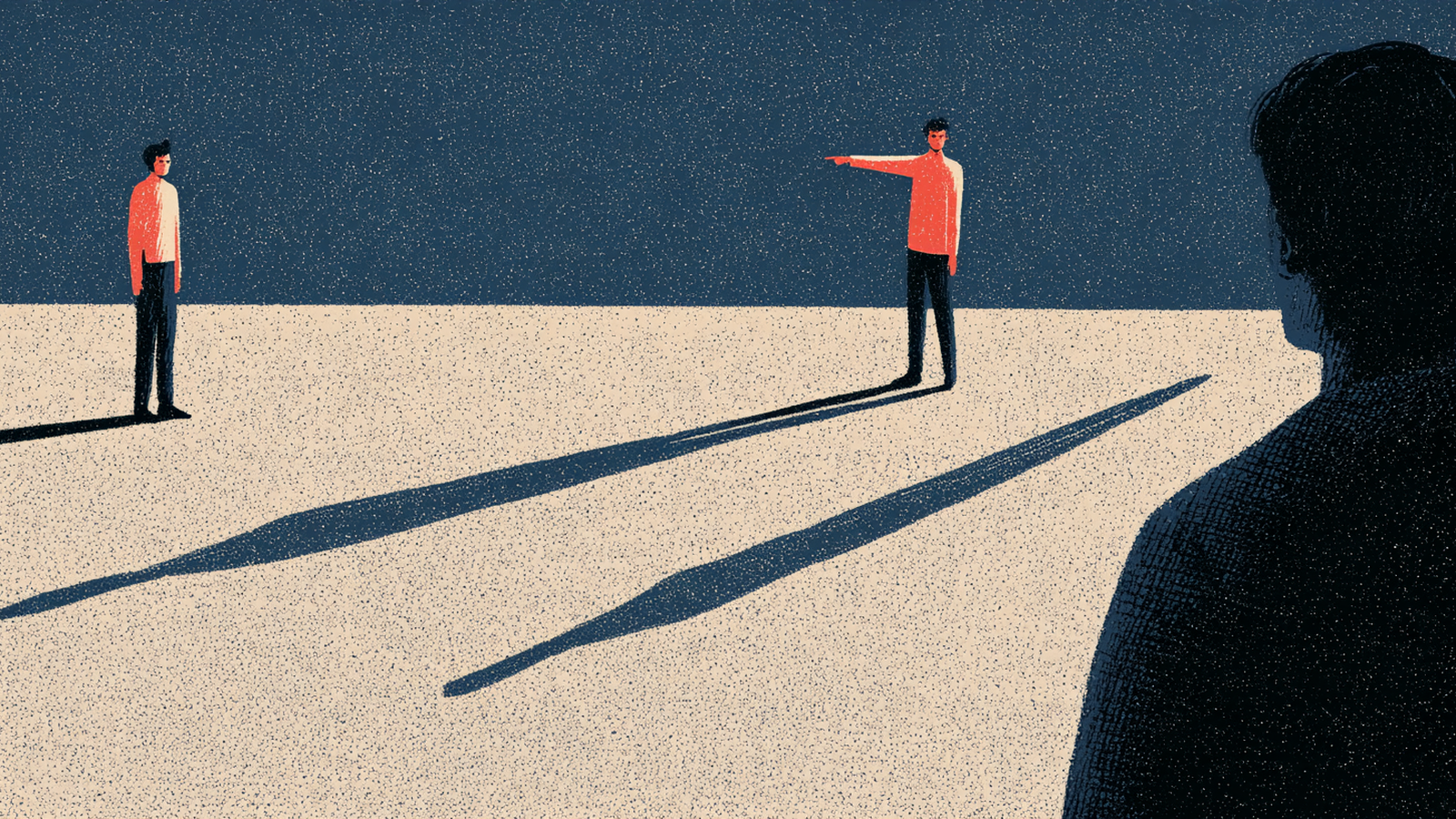
You get the promotion, or the degree, or the finished manuscript, and the satisfaction lasts about an afternoon. Then a quieter feeling arrives, a sense of being somewhere short of where you were supposed to be, even though nothing objective has gone wrong.
Psychologists have a name for the structure behind that feeling. Self-discrepancy theory, published by E. Tory Higgins in 1987, proposes that the distance between who you are and who you believe you should or could be produces specific emotions, and that the kind of distance shapes the kind of emotion.
Key Takeaways
- Self-discrepancy theory is the proposal by E. Tory Higgins (1987, Psychological Review) that gaps between a person’s actual self and their ideal or ought self signal different emotional vulnerabilities.
- The theory names three domains of the self (actual, ideal, ought) and two standpoints (your own and a significant other’s).
- Higgins (1987) predicted that actual:ideal gaps go with dejection-related emotions such as disappointment, dissatisfaction and sadness, and that actual:ought gaps go with agitation-related emotions such as fear, threat and restlessness.
- Tangney, Niedenthal, Covert and Barlow (1998) tested 229 undergraduates and reported no support for the central hypotheses of the theory.
- A meta-analysis of 70 studies (Mason et al., 2019) found a small-to-medium association between self-discrepancy and psychopathology, and found that the specific pairing of ideal gaps with depression and ought gaps with anxiety was not supported.
The three selves: actual, ideal and ought
Higgins built the theory on a simple set of definitions. In his 1987 paper, each self-state representation combines one domain of the self with one standpoint on the self.
The three domains are these:
- The actual self. Your representation of the attributes that you, or someone significant to you, believe you actually possess.
- The ideal self. Your representation of the attributes someone would like you to possess: the hopes, wishes and aspirations held for you.
- The ought self. Your representation of the attributes someone believes you should possess: duties, responsibilities and obligations.
The two standpoints are your own and that of a significant other, such as a parent or a partner. Crossing domain with standpoint gives a set of self-states, and the theory looks at the mismatches between the actual self and each of the guides, the ideal and the ought.
A short way to hold all of this: the actual self is the description, the ideal self is the aspiration, and the ought self is the obligation.
Ideal self and ought self: two different gaps
The keyword people type most often is some version of ideal self vs ought self. Higgins gave each one its own portrait, and the portraits predict different feelings.
An ideal self is a picture of what would be wonderful. When the actual self falls short of it, Higgins proposed, the person experiences the absence of positive outcomes. His 1987 paper links that situation to dejection-related emotions, with disappointment, dissatisfaction and sadness as the examples.
An ought self is a picture of what is required. When the actual self falls short of it, the person faces the presence of negative outcomes, such as criticism or punishment. The paper links that situation to agitation-related emotions, with fear, threat and restlessness as the examples.
Set side by side, the two are a pair of different weather systems. The ideal gap is the grey, heavy kind: something good did not arrive. The ought gap is the electric kind: something bad might.
Two further ideas complete the model. The theory predicts that the size of a person’s gaps matters, and that how easily a gap comes to mind (its accessibility) matters too, so two people with similar gaps can feel different amounts of discomfort depending on which gap is active at the moment.
What Higgins’s self-discrepancy theory studies reported
The 1987 paper presents correlational and experimental evidence. Higgins and colleagues had undergraduates complete a Selves questionnaire, in which respondents list up to 10 traits or attributes for each self-state, alongside measures of chronic discomfort and emotional symptoms.
The paper also describes a latent-variable study by Strauman and Higgins with 163 introductory psychology students. In that model, the discrepancy between the actual/own self and the ideal/own self was uniquely associated with depression, and the discrepancy between the actual/own self and the ought/other self was uniquely associated with social anxiety. Higgins wrote that the results strongly supported the predictions of the theory.
The abstract of the 1987 paper summarizes the whole body of work this way: correlational and experimental evidence supports the predictions of the model. That summary was the author’s own, written when the theory was new.
What later tests found
Later researchers ran the predictions again, and the results were mixed. Two studies give the clearest picture.
Tangney et al. (1998). In a study of 229 undergraduates, Tangney and colleagues examined whether specific self-discrepancies relate to shame proneness and guilt proneness. They reported that shame proneness was positively related to all types of self-discrepancies, while guilt proneness showed no positive relation to them. They also tried to replicate the 1985 Higgins, Klein and Strauman findings that specific self-discrepancies go with distinct emotion syndromes, and reported finding no support for the central hypotheses of the theory. Their abstract also raises a measurement question: different types of self-discrepancies correlated very highly with each other within each method, which raises discriminant validity concerns.
Mason et al. (2019). This meta-analysis pooled 70 studies on self-discrepancy and psychopathology. It found a small-to-medium association between self-discrepancy and psychopathology that was highly robust and similar in size across domains. Self-discrepancy went with higher levels of a range of negative emotions and lower levels of a range of positive emotions.
On the specific prediction, the meta-regression found that effects were greater for actual:ideal discrepancy than for actual:ought discrepancy for both depression and anxiety. The authors state that the tenet of unique pairings, ideal with depression and ought with anxiety, was not supported. Measurement type also mattered: nomothetic measures showed greater associations than idiographic measures for depression and anxiety.
The authors read their findings as suggesting that self-discrepancy is a contributory factor related to a number of psychiatric disorders.
Shame, guilt and the 2023 follow-up
Some later work places shame and guilt between the gap and the symptom. Oh, Lee and Cho (2023) surveyed 403 participants online on self-discrepancy, shame, guilt, depression and anxiety.
They found positive correlations among all six variables. Shame partially mediated the association between actual/ideal self-discrepancy and depression, and guilt fully mediated the association between actual/ought self-discrepancy and anxiety. The authors concluded that the outcomes upheld the theory.
This study is a cross-sectional survey, so it describes how the variables line up at one moment. The pattern it reports matches Higgins’s original pairing, while the meta-analysis found the broader association across all discrepancy types. Both can stand as findings: an association is well supported, and the specific map from gap to emotion remains disputed. For a closer look at the two emotions in that survey, see the page on the difference between shame and guilt.
Where the theory meets the inner critic
Most of the studies above use questionnaires, which means most of the evidence concerns self-reports gathered at one time. That limits what anyone can say about cause. A gap might produce low mood, low mood might make gaps feel larger, or something else might drive both.
Even so, the three-selves vocabulary gives a useful way to listen to your own mind. The voice that says “you should have finished by now” speaks from the ought self. The voice that says “you were supposed to be someone by thirty” speaks from the ideal self. If you want to meet that voice in more detail, what the inner critic is is the place to start.
The same vocabulary can shed light on feeling adrift. The page on feeling like you lost yourself describes how a gap between the actual and ideal self can feel like a loss of identity, and the page on feeling sad for no reason covers moods that arrive without an obvious cause.
If gaps like these come with persistent low mood, ongoing anxiety or thoughts of self-harm, a doctor or licensed mental health professional is the right person to talk to, and reaching out to one is a sound act of care for yourself.
Questions you can write out
Self-discrepancy theory suggests a short set of questions that anyone can answer on paper. They are prompts for reflection and carry no scoring.
- Whose voice describes the ideal self in my mind: mine, a parent’s, a culture’s?
- Whose voice describes the ought self, and what does that voice say will happen if I fall short?
- When I feel flat, which gap is loudest right now?
- When I feel tense, which gap is loudest right now?
- Which of these standards would I still choose, if I were choosing today?
A gentler way to hold the gap
The three selves are mental representations, and representations can be revisited. The ideal self you carry was assembled from hopes that were handed to you or that you wrote at some earlier age. The ought self was assembled from obligations, spoken and unspoken.
A gap between the actual and the ideal is a sign that you hold aspirations, and an ought gap is a sign that you care about your commitments. Meeting the feeling with self-compassion lets you look at the distance with kindness, and from that steadier place decide which standards deserve to stay.
The next time the quiet disappointment arrives after a win, you might ask which self is speaking, and whose hope it carries.
Related reading
References
Higgins, E. T. (1987). Self-discrepancy: A theory relating self and affect. Psychological Review, 94(3), 319-340.
Mason, T. B., Smith, K. E., Engwall, A., Lass, A., Mead, M., Sorby, M., Bjorlie, K., Strauman, T. J., & Wonderlich, S. (2019). Self-discrepancy theory as a transdiagnostic framework: A meta-analysis of self-discrepancy and psychopathology. Psychological Bulletin, 145(4), 372-389.
Oh, H., Lee, D. G., & Cho, H. (2023). The differential roles of shame and guilt in the relationship between self-discrepancy and psychological maladjustment. Frontiers in Psychology, 14, 1215177.
Tangney, J. P., Niedenthal, P. M., Covert, M. V., & Barlow, D. H. (1998). Are shame and guilt related to distinct self-discrepancies? A test of Higgins’s (1987) hypotheses. Journal of Personality and Social Psychology, 75(1), 256-268.