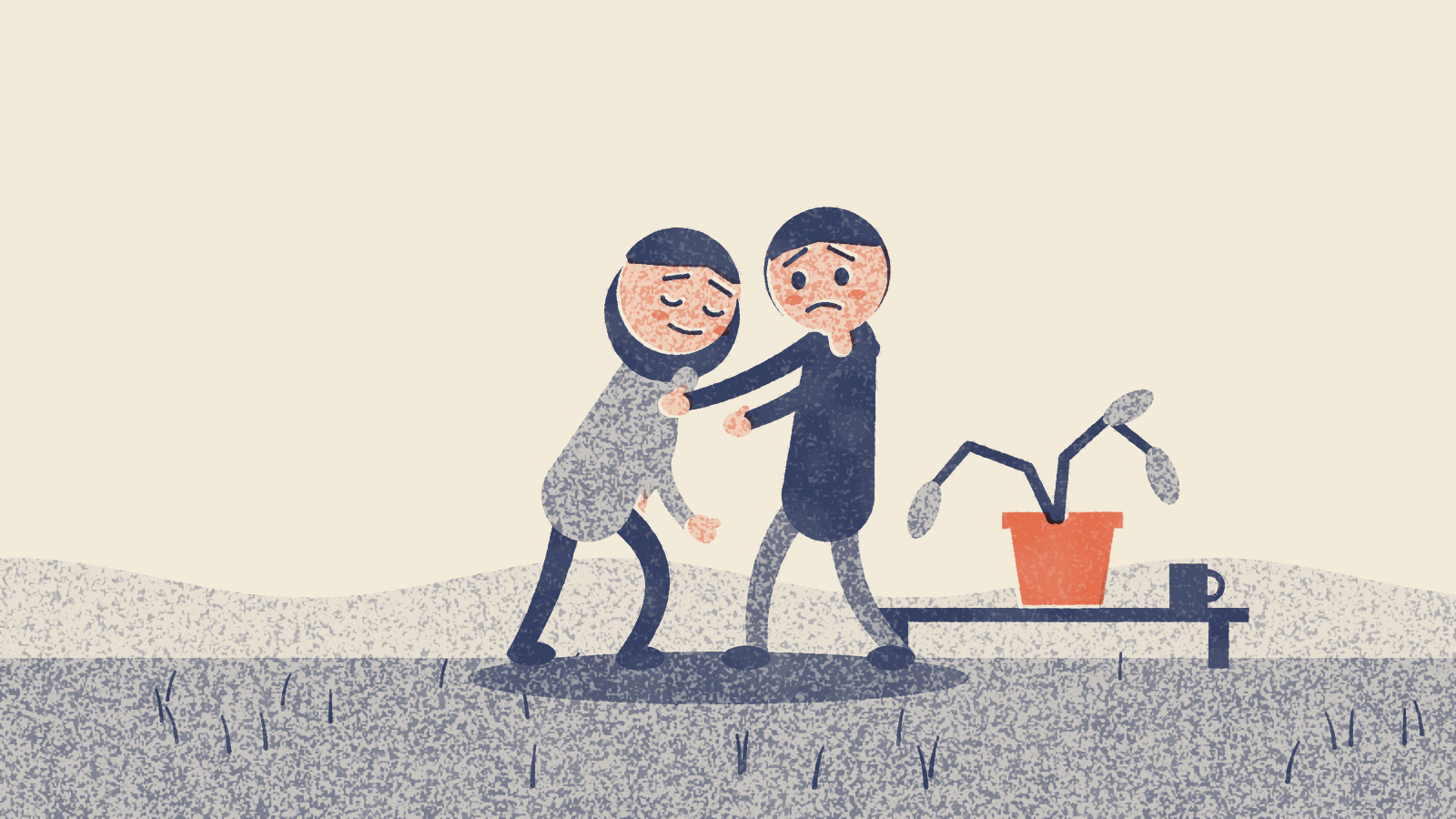
You cancel your plans because their mood shifted. You answer a message you have no energy for, because an unanswered message would cost you the evening. Somewhere inside a close relationship your attention has settled so fully on the other person that your own preferences have gone quiet. Someone who notices this might search for codependency in relationships, hoping to find a name for what they are living.
Key Takeaways
- Codependency is not listed in the DSM, and researchers writing in 2018 reported that no universally used definitions or diagnostic criteria exist (Bacon et al., 2020).
- A thematic analysis of 11 published definitions found four recurring elements: external focusing, self-sacrificing, attempting to control other people, and suppressing one’s emotions (Dear et al., 2004).
- The authors of that analysis concluded that although a clear definition emerged, the definition does not show that a codependency disorder actually exists (Dear et al., 2004).
- In an interview study of eight UK participants recruited from codependency support groups, self-identified codependents described three linked experiences: a lack of clear sense of self, an enduring pattern of extreme emotional, relational and occupational imbalance, and an attribution of current problems to parental abandonment and control in childhood (Bacon et al., 2020).
- The practices near the end of this page are suggestions to try. No study cited here tested them.
What people mean by codependency in relationships
Codependency is a word with a long history and a loose definition. Bacon and colleagues call it a “complex and contested concept” that mental health professionals have used to inform their practice, and they note that it has a strong presence in the psychological self-help literature (Bacon et al., 2020).
According to the same paper, the idea emerged in the 1940s in the context of treatment for substance misuse in the United States. Early interpretations were associated with the behaviors of wives of alcoholics, and the culture of Alcoholics Anonymous in the 1960s and 1970s shaped the view that people close to a substance user were themselves suffering from an illness (Bacon et al., 2020).
Because codependency is not a DSM diagnosis, anyone using the word is borrowing a descriptive term, and the borrowed term carries the disagreements of the field with it.
Four elements that keep turning up in definitions
Greg Dear, Clare Roberts and Lois Lange gathered 11 published definitions of codependency and looked for what they had in common. Four elements recurred (Dear et al., 2004):
- External focusing. Attention rests on other people.
- Self-sacrificing. The person gives up their own needs or wishes.
- Attempting to control other people. The person tries to steer what others do.
- Suppressing one’s emotions. The person holds their own feelings back.
The other characteristics listed in definitions were clarifications of these four, widely recognized psychological phenomena, or features that appeared in only a minority of definitions (Dear et al., 2004).
Dear and colleagues drew a careful line around their result. They found that a clear definition emerged, and they noted that the definition does not show a codependency disorder exists. They also called for psychometrically sound measures of each of the four components (Dear et al., 2004).
Read this way, the four elements work as a vocabulary for describing a pattern. They give you words for what you might be noticing, and they stay open about whether the pattern is a disorder.
How the pattern is described from the inside
Eight people recruited from local codependency support groups in the UK took part in an interpretative phenomenological analysis, using interviews and a visual method. Their shared experience was described as a multidimensional psychosocial problem in their lives. It incorporated three interlinked experiences (Bacon et al., 2020):
- A lack of clear sense of self.
- An enduring pattern of extreme emotional, relational and occupational imbalance.
- An attribution of current problems to parental abandonment and control in childhood.
The paper describes a small group who identified as codependent, so these themes describe how those eight people made sense of their lives. They offer a window into the lived texture of the idea.
Everyday versions of the first two themes might look like this:
- Someone asks what you want for dinner, and you scan their face before answering.
- A weekend plan changes shape three times to fit a partner’s mood, and you notice you have not mentioned the plan you wanted.
- You feel responsible for a friend’s bad day, and the day only ends well for you when theirs does.
These are illustrations of how the themes could appear. Each person’s version differs.
Three models and why the argument continues
Bacon and colleagues describe three models that came to the forefront from the 1980s onward (Bacon et al., 2020):
- The disease model, which places codependency within clinical intervention, diagnosis and treatment.
- The personality model, which highlights personality and constitutional factors that predispose a person to develop it.
- The interactionist model, which combines interpersonal and intrapersonal factors in how it develops and is maintained.
The authors report that the concept has attracted criticism for lack of clarity, strong stereotyping, and negative labelling, and that researchers’ evidence on the main problems associated with it is still inconclusive. They also say the models have arguably a reductionist perspective, limiting understanding of the experience to psychological categories, traits and illness (Bacon et al., 2020).
That is useful context if you are using the word about yourself. A label that can hold so many meanings might describe your experience well in one conversation and miss it in the next.
Where attachment ideas fit
Attachment research offers a second vocabulary for closeness. Fraley’s overview describes secure adults as low on both attachment-related anxiety and avoidance, anxious-resistant adults as people who worry that others may not love them completely, and avoidant adults as people who may appear not to care too much about close relationships and may prefer not to be too dependent on other people (Fraley, n.d.).
The overview also reports that Hazan and Shaver proposed that adult romantic bonds partly reflect the attachment system that shapes infant-caregiver bonds. In its closing questions for future research, it adds that “it is probably the case that, while some romantic relationships are genuine attachment relationships, others are not” (Fraley, n.d.).
The sources cited on this page do not test how codependency relates to attachment style. You may still find the two vocabularies useful side by side. The page on attachment styles lays out the four patterns, and the page on avoidant attachment style describes the type that is uncomfortable with closeness.
Neighbors of the pattern: people pleasing and guilt
Codependency in relationships shares ground with other everyday ideas. People pleasing is one of them, and the page on how common people pleasing is looks at what polls and scales count when they try to measure it.
Guilt is another. The page on guilt tripping gives words to moments when a feeling of obligation arrives before you have decided anything.
You may also find that putting your own goals last in a close relationship starts to look like self sabotaging in relationships. You can examine that overlap in your own life.
Practices to try when you notice the pattern
The following are practices, offered as suggestions to experiment with. No study cited here tested them.
- Name the pull. When you feel your attention fixing on someone else’s mood, say silently, “my attention just moved to them.” Naming it gives you a moment before you act.
- Say one preference out loud each day. Pick something small, such as the restaurant or the movie, and state your choice before you ask for theirs.
- Write two columns. On one side, list what you did for someone this week. On the other, list what you did for yourself. Look at the page without judging it.
- Ask whose feeling it is. When a wave of worry or responsibility arrives, ask whether it started in you or in the other person.
- Notice what you hold back. Over a week, jot down any feeling you swallowed in a conversation. The list shows you which feelings you tend to edit out.
If the pattern is causing you real distress, or you are in a relationship where you feel unsafe, a licensed therapist or counselor can help you sort it out with you in the room.
Something to sit with
A word that nobody has pinned down can still point at an ache. For the eight people in one study, codependency felt real and tangible, and discovering the concept offered meaning to experiences they had found complex and confusing.
You are the best witness to your own relationships. When you look at yours, ask where your attention rests most of the day, and what it would feel like to let some of it come home.
Related reading
- How to Stop Self-Sabotaging Your Relationships
- Self Sabotage and Avoidant Attachment
- Am I Self-Sabotaging My Relationship?
Related reading: What Is Self-Sabotage?.
References
Bacon, I., McKay, E., Reynolds, F., & McIntyre, A. (2020). The lived experience of codependency: An interpretative phenomenological analysis. International Journal of Mental Health and Addiction, 18(3), 754-771.
Dear, G. E., Roberts, C. M., & Lange, L. (2004). Defining codependency: A thematic analysis of published definitions. In S. Shohov (Ed.), Advances in psychology (Vol. 34, pp. 189-205). Nova Science Publishers.
Fraley, R. C. (n.d.). A brief overview of adult attachment theory and research. University of Illinois at Urbana-Champaign.