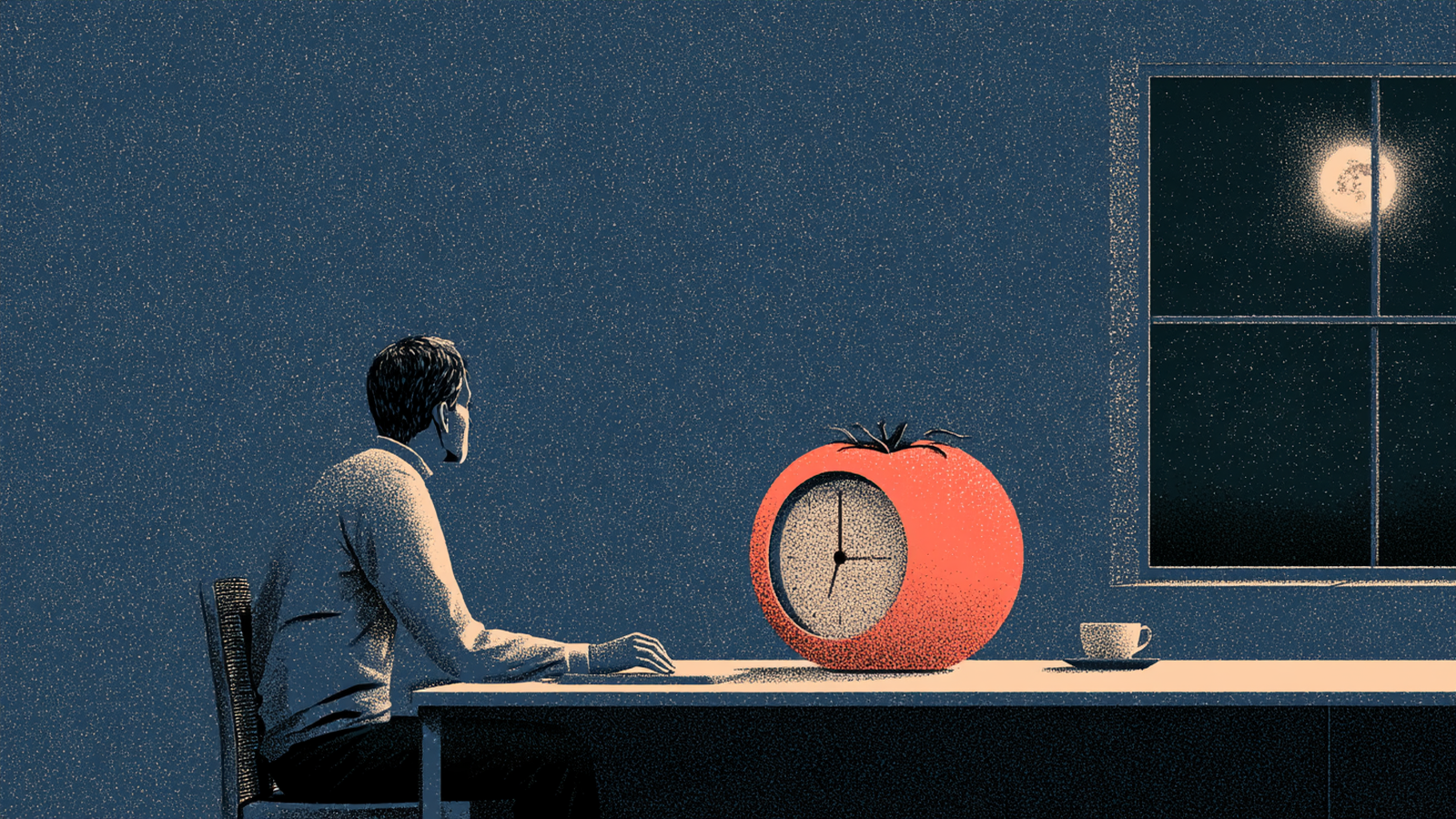
A task has been sitting on your list for days. You know roughly what it involves, and each time you open the file, something else suddenly looks more urgent. The thought of “working on it for a few hours” is the very thing that keeps you from beginning.
The Pomodoro Technique offers a smaller door. You agree to work for a short, fixed stretch, then you stop. This article looks at how the technique works, what research on work breaks says about it, and where it earns its place for people who delay.
Key Takeaways
- The Pomodoro Technique, created by Francesco Cirillo as a college student, divides work into 25-minute intervals separated by 5-minute breaks (Cirillo, 2018).
- In an experiment on vigilance, Ariga and Lleras (2011) found that performance declined over time when people stayed on one task, and that the decline was avoided when they were prompted to briefly switch to a different task.
- A meta-analysis of micro-breaks (breaks of no longer than 10 minutes) covering 22 samples and 2,335 participants found small effects on vigor (d = .36) and fatigue (d = .35) (Albulescu et al., 2022).
- The same meta-analysis found no significant overall effect of micro-breaks on performance (d = .16, 95% CI [-.04, .37]), and longer breaks were linked to larger performance gains.
- The 25-minute length is a convention. The research reviewed here does not test 25 minutes against other lengths.
What the Pomodoro Technique is
Francesco Cirillo developed the method as a university student, using a tomato-shaped kitchen timer. “Pomodoro” is the Italian word for tomato. In his 2018 book, he describes dividing work into 25-minute intervals with 5-minute breaks between them.
Each interval is one pomodoro. You pick a task, set the timer, and work on that task until it rings. Then you step away for the short break and start the next one.
The method’s own site frames it as a cycle of planning, focusing and reflecting. You choose the work and estimate the effort, you work on one activity at a time with regular breaks, and you record how it went so your estimates improve. The mechanics of that focus practice already have a home in how to focus, which describes the method’s origin and how a timed block fits with research on attention. This page picks up from there with a different question: what do we know about the breaks?
Does the Pomodoro Technique work? What the research says
Cirillo’s method is a working system that many people report using. No study reviewed for this article tested the Pomodoro Technique itself against a control condition. What exists is a body of research on breaks in general, and it can be read for what it suggests about the method.
The most useful way to hold the question is to split it in two. One part asks whether short breaks help attention during a long task. The other asks whether 25 minutes is a special length. The first part has some support. The second part has no support in these studies.
Brief breaks and sustained attention
In a 2011 paper in Cognition, Atsunori Ariga and Alejandro Lleras studied the vigilance decrement, the familiar slide in performance on a long, monotonous task. Participants did a visual vigilance task while holding digits in memory. When they recalled the digits only at the end, performance declined over time. When they were prompted to recall the digits sporadically during the task, the decline was avoided (Ariga & Lleras, 2011).
The authors proposed that the decline comes from the control system failing to keep the task’s goal active, and that a brief switch lets the goal be deactivated and then reactivated. That reading challenges the common view that attention drains like a tank.
The interruptions in this study were short digit-recall prompts. A pomodoro break lasts about five minutes and usually means leaving the desk. The study supports the general idea that periodic interruptions can protect sustained attention. It tests a shorter and different kind of interruption than Cirillo’s break.
Micro-breaks and well-being
Albulescu and colleagues pooled 19 records, giving 22 independent samples and 2,335 participants, in a 2022 meta-analysis in PLOS ONE. They defined micro-breaks as short discontinuities in a task lasting no more than 10 minutes. Micro-breaks produced small but significant effects on vigor (d = .36, 95% CI [.16, .55]) and on fatigue (d = .35, 95% CI [.19, .50]) (Albulescu et al., 2022).
The effect on performance was small and did not reach significance (d = .16, 95% CI [-.04, .37]). Break length mattered for performance: longer breaks were associated with larger gains. The type of task mattered too. After cognitive tasks breaks did not seem to affect performance, while the authors suggest that recovering from highly depleting work may call for breaks longer than 10 minutes.
In plain terms, a five-minute break is likely to leave you feeling a little fresher. Whether it makes the work itself better is still open, and that deserves to be said as clearly as the encouraging part.
Is 25 minutes a magic number?
Nothing in the studies above points to 25 minutes. Ariga and Lleras used their own task timings, and Albulescu’s review covers breaks of up to 10 minutes across many designs and work lengths. The research tells us that brief, regular breaks can help with vigor and fatigue. It does not rank 25-minute blocks against 15-minute or 50-minute ones.
That leaves the interval as a convention. A convention can still be useful, since a fixed length removes a decision, and the timer carries the job of telling you when to stop. If you feel your attention fading at 18 minutes, or holding well at 40, adjusting the length fits the way the evidence is actually shaped.
The Pomodoro Technique as a way to start
For people who delay, the most practical feature of the method is the ending. A 25-minute window gives a vague, heavy task a visible edge, and it is easier to begin something when you know it will stop.
Fuschia Sirois and Timothy Pychyl describe procrastination as a short-term mood repair strategy, in which relief from an unpleasant feeling gets priority over the action that would serve the future self (Sirois & Pychyl, 2013). A small timed block lowers the emotional price of starting, which may be why it suits that pattern. This is an interpretation of how the two ideas fit together, and no study has tested the Pomodoro Technique on procrastination.
A starting version looks like this:
- Choose one task and write down its first physical action.
- Set the timer for 25 minutes, or for 10 if 25 feels like too much.
- Work on that single task until the timer rings.
- Take the break away from your screen.
- Decide afterward whether to run another round.
Many people find that the hardest minute is the first one, and that the block carries them along once they are in it. If the delay has roots in dread of the task or of how it might turn out, procrastination and anxiety describes how that loop feeds itself. For the wider set of patterns behind a stall, overcoming procrastination walks through them.
When a timer is not enough
Some people find that a timer changes little, because starting stays difficult no matter how short the block is. Attention and task initiation can be affected by ADHD, anxiety and low mood, and a method built on willpower in 25-minute pieces may fall short for those experiences. Is procrastination a sign of ADHD looks at where the overlap lies. If your difficulty starting or staying with tasks is persistent or distressing, a conversation with a doctor or a licensed mental health professional is a kind step to take for yourself.
A method to try on your own days
The research gives the Pomodoro Technique a modest and honest footing. Short breaks seem to help people feel more energetic and less tired, the effect on output is uncertain, and the number 25 is a starting point that you can reshape.
You might run it for a week and keep a note after each block: how did the first five minutes feel, and how did the last five minutes feel? Your own notes will say more about the right length than any average can.
Related reading
- ADHD Procrastination: Why Your Brain Works Differently
- Bedtime Procrastination Statistics: How Common Going to Bed Late Really Is
- Chronic Procrastination: When Delay Becomes a Way of Life
References
Albulescu, P., Macsinga, I., Rusu, A., Sulea, C., Bodnaru, A., & Tulbure, B. T. (2022). “Give me a break!” A systematic review and meta-analysis on the efficacy of micro-breaks for increasing well-being and performance. PLOS ONE, 17(8), e0272460.
Ariga, A., & Lleras, A. (2011). Brief and rare mental “breaks” keep you focused: Deactivation and reactivation of task goals preempt vigilance decrements. Cognition, 118(3), 439-443.
Cirillo, F. (2018). The Pomodoro Technique: The acclaimed time-management system that has transformed how we work. Currency.
Sirois, F., & Pychyl, T. (2013). Procrastination and the priority of short-term mood regulation: Consequences for future self. Social and Personality Psychology Compass, 7(2), 115-127.