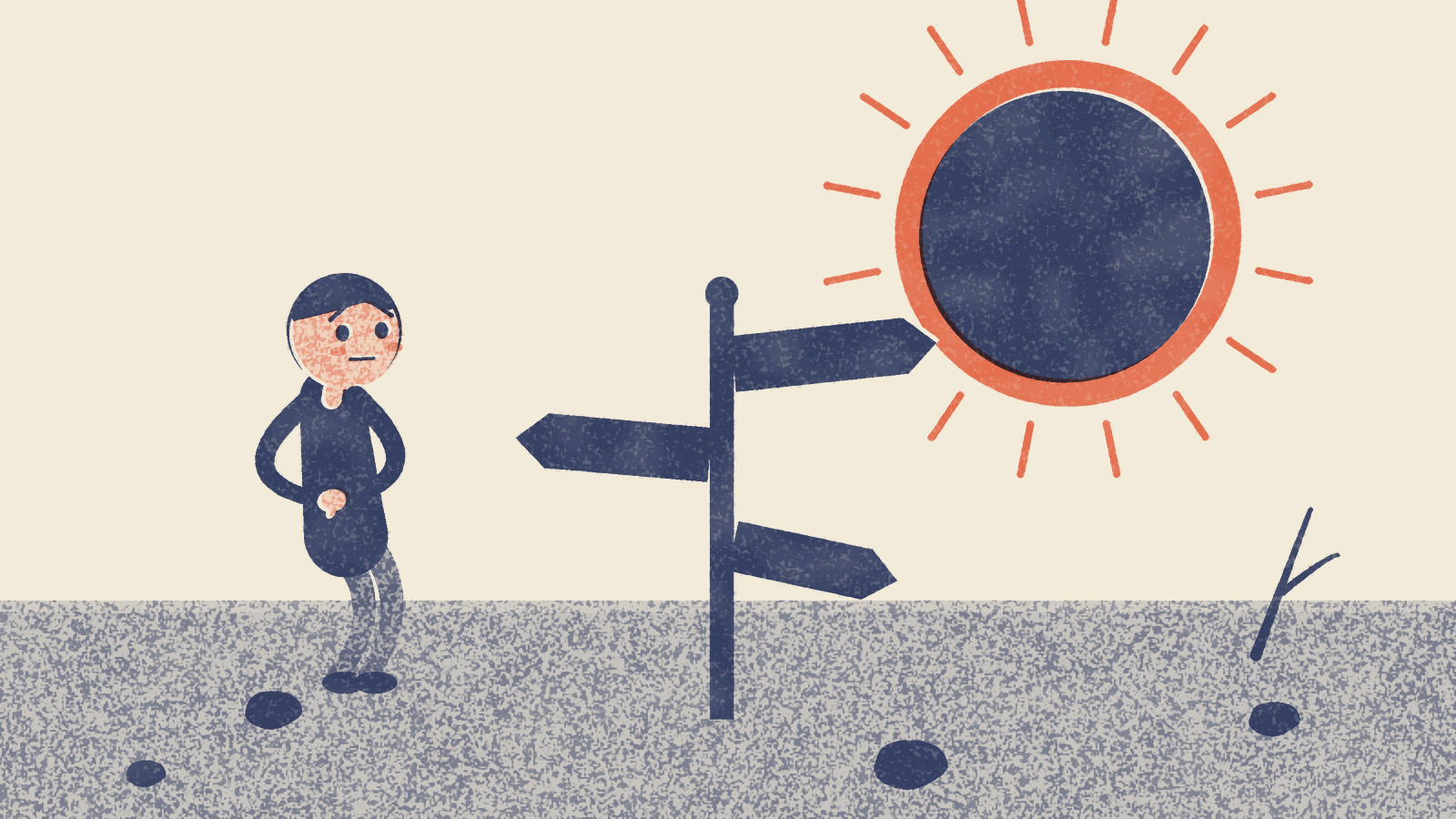
Somewhere between the third email of the morning and the fourth hour of scrolling, a thought arrives that sounds almost casual: none of this matters. The thought can pass in a second, or it can settle in for a season. Either way it raises an old question, and philosophy has a name for the position the thought points toward.
That name is nihilism. If you have been asking what is nihilism, and whether it describes the flat, gray mood you are in, the answer starts with a definition and then moves through its main kinds, a famous prediction from Nietzsche, and the most quoted reply anyone has offered.
Key Takeaways
- The Internet Encyclopedia of Philosophy defines nihilism as “the belief that all values are baseless and that nothing can be known or communicated”, and describes several kinds, among them existential, moral, epistemological and political nihilism.
- Existential nihilism holds that life has no intrinsic meaning or value, and the Internet Encyclopedia of Philosophy calls it the most commonly used and understood sense of the word today.
- The same encyclopedia says Nietzsche is the thinker most often associated with nihilism, and that he predicted it would undermine moral, religious and metaphysical convictions and precipitate a great crisis.
- Albert Camus accepts that the universe offers no answer about purpose, and names the gap between that silence and the human demand for meaning the absurd (Aronson, 2021).
- Camus answers the absurd with revolt: lucid defiance that keeps living and refuses to look for comfort in another world, which is why he asks us to imagine Sisyphus happy.
What is nihilism, in one sentence
The word comes with a family of meanings. The Internet Encyclopedia of Philosophy entry by Alan Pratt opens with the broadest one: nihilism is the belief that all values are baseless and that nothing can be known or communicated.
That sentence is the umbrella. Under it sit several narrower claims, and most conversations about nihilism are about only one of them. Which one you mean decides what you are actually arguing for or against.
The main kinds of nihilism
Pratt’s entry sorts the term into a handful of kinds. Four of them cover most of what people mean:
- Existential nihilism holds that life has no intrinsic meaning or value. Pratt calls this the most commonly used and understood sense of the word today.
- Moral (ethical) nihilism rejects absolute moral values. Good and evil are described as nebulous, and moral values are traced to social and emotive pressures.
- Epistemological nihilism denies that knowledge and truth are possible, and the entry links it to extreme skepticism.
- Political nihilism holds that existing political, social and religious order must be destroyed before any improvement can happen.
When someone online announces that they are a nihilist, they usually mean the first kind. The claim concerns the universe and your place in it: no purpose is built into things, and nothing outside you hands you a reason to exist.
The moral kind addresses a different question. Existential nihilism says life lacks built-in meaning, while moral nihilism says right and wrong lack absolute standing.
Nietzsche and the crisis he predicted
Friedrich Nietzsche is the name that comes up first. Pratt’s entry says he is the thinker most often associated with nihilism, and it describes him as predicting that nihilism would undermine moral, religious and metaphysical convictions and precipitate “the greatest crisis in human history.”
The entry also says Nietzsche believed humanity could, at a terrible price, eventually work through nihilism. In Pratt’s account, Nietzsche describes the arrival of nihilism as a catastrophe toward which European culture is moving, and treats the outcome as a question of humanity’s strength.
Pratt also quotes him on the other side of the ledger: Nietzsche says he does not reproach nihilism’s arrival and calls it a moment of the deepest self-reflection of humanity.
When the question stops being abstract
Philosophers hold nihilism as a position. Most people meet it as a mood. The mood arrives after a goal is reached and feels empty, or after a long stretch of obligations that never asked what they were for.
It tends to show up in a few recognizable ways:
- Tasks that used to carry weight feel interchangeable.
- Every reason you give for doing something gets followed by “and then what?”
- Ambition and apathy trade places without warning.
A mood shifts with sleep, company and season. A philosophical position is a claim you can examine. If the flat feeling has settled in and is wearing you down, what to do when life feels meaningless takes up the practical side. This article stays with the ideas.
Camus and the absurd
Albert Camus took the nihilist premise seriously and asked what follows from it. In the Stanford Encyclopedia of Philosophy, Ronald Aronson (2021) describes the absurd as the gap between the human impulse to ask about life’s purpose and the impossibility of any adequate answer.
The Internet Encyclopedia of Philosophy entry on Camus by David Simpson quotes Camus placing the absurd in the presence of the human being and the world together. The absurd is a relationship. It appears when a mind that wants order meets a universe that stays silent.
That framing gives the absurd an address. You locate it in the meeting of the cosmos and your own mind, at the point where the question meets the silence.
What The Myth of Sisyphus asks
Camus’s essay The Myth of Sisyphus (1942/1991) begins with a question that sounds severe. According to Aronson, Camus says there is “only one really serious philosophical problem,” and that it is suicide, which Aronson reads as the question of whether life is worth living, treated as an urgent matter of life and death.
Simpson’s entry says Camus rejected physical suicide as a renunciation of life and an abandonment of revolt. It also describes what Camus calls philosophical suicide: religious or transcendent escapes from the absurd, which Simpson calls transparently evasive.
What remains is revolt. Aronson describes it as lucid defiance that refuses both hope in another life and resignation, and that keeps the tension of the human condition alive. Simpson notes that Sisyphus, who keeps pushing his rock though he knows the task is hopeless, becomes the model of this defiance.
The essay closes with the line most readers remember: “One must imagine Sisyphus happy.” Aronson reads this as Camus’s claim that happiness and the absurd can coexist.
How Camus’s reply sits beside Stoicism
Camus’s answer has a sibling in the ancient world. The Stoics also faced a universe that does not arrange itself around our wishes, and their reply was a discipline of attention to what lies within your control. What Is Stoicism? lays out that school on its own terms.
Camus separated himself from the existentialist label. Simpson’s entry says he repeatedly denied that he was an existentialist, giving reasons such as his avoidance of metaphysics and his belief in a common human nature. One way to hold his position is to look at the silence directly and keep going.
Aronson adds a warning from the other end. In The Rebel, Camus describes a modern drift in which revolt turns into an “ever more desperate nihilism.” Simpson’s entry says the book takes up whether terrorism and political violence can be morally justified, and that Camus’s critique of terror in it touched nerves throughout Europe. Camus’s own reply to the absurd, as these entries tell it, keeps revolt tied to life.
A question to sit with
Nihilism, in its existential form, makes one claim: no meaning comes built into the universe. Camus accepts that premise and still describes a life worth living, one lived with open eyes and without the consolation of an answer from outside.
If you read the premise as true, a quieter question remains. When you imagine Sisyphus at the bottom of the hill, turning back toward the rock, what would it take for you to picture him content? Your answer may say something about what you already believe about your own days.
For further reading on the thinkers who built this conversation, best existentialism books for beginners is a good place to start.
Related reading
- Existential Suffering: Finding Meaning in Pain That Doesn’t Resolve
- What Is an Existential Question? The Kind That Keeps Coming Back
- Existential Dread vs Existential Crisis: What Each One Actually Is
References
Aronson, R. (2021). Albert Camus. In The Stanford encyclopedia of philosophy.
Camus, A. (1991). The myth of Sisyphus and other essays (J. O’Brien, Trans.). Vintage International. (Original work published 1942)
Pratt, A. (n.d.). Nihilism. In Internet encyclopedia of philosophy.
Simpson, D. (n.d.). Albert Camus. In Internet encyclopedia of philosophy.