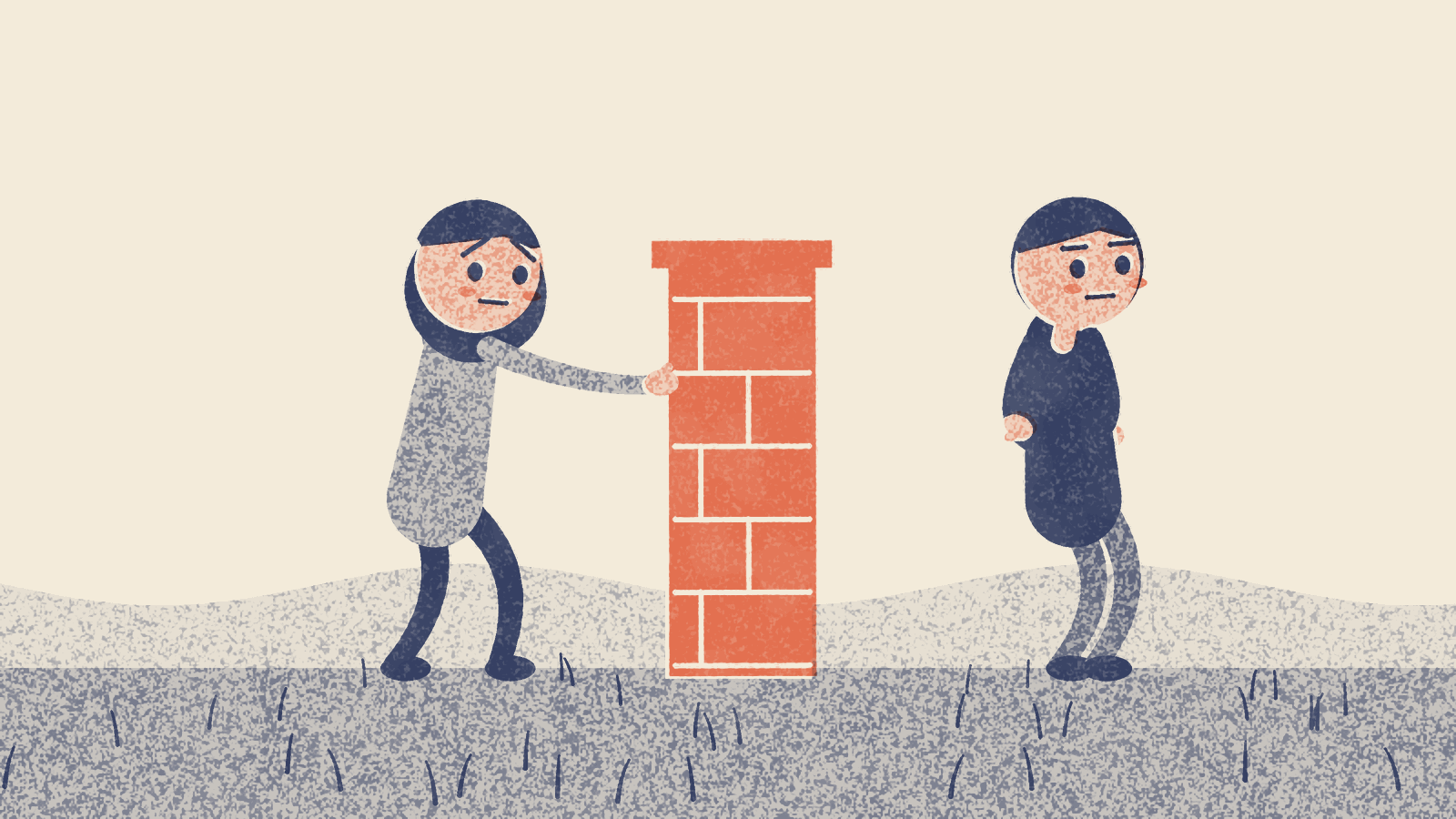
Things are going well. The conversations are warm, the person beside you is kind, and somewhere around the third month a quiet urge arrives to take a step back. You find yourself needing a weekend alone, or an evening of silence, or a reason to keep one part of your life closed. The avoidant attachment style is the name researchers give to this pattern, a habit of managing closeness by keeping some distance from it.
Key Takeaways
- The avoidant attachment style is a research description of adults who feel discomfort with closeness and with depending on others in close relationships (Brennan et al., 1998).
- Mikulincer and Shaver describe the core of avoidance as deactivating strategies: denying attachment needs, pursuing self-reliance, and keeping cognitive, emotional, and physical distance from a partner (Mikulincer & Shaver, 2003).
- In the attachment account, these strategies consolidate after repeated experiences of an unavailable attachment figure combined with a negative appraisal of whether seeking closeness is worth it (Mikulincer & Shaver, 2003).
- Bartholomew and Horowitz’s four-category model separates dismissing avoidants (high avoidance, low anxiety) from fearful avoidants (high on both), and extremely high scores on both dimensions are more common in abused or clinical samples (Bartholomew & Horowitz, 1991; Mikulincer & Shaver, 2003).
- In a nationally representative U.S. sample published in 1997, 25 percent of adults were classed as avoidant, 11 percent as anxious, and 59 percent as secure (Mickelson et al., 1997).
What the avoidant attachment style is
Attachment research asks how people manage closeness when they feel threatened or stressed. Cindy Hazan and Phillip Shaver brought the question into adult romance, describing three styles (secure, avoidant, and anxious or ambivalent) and proposing that mental models of the self and of relationships, shaped partly by childhood experience with parents, carry into adulthood (Hazan & Shaver, 1987).
The avoidant style is the one organised around self-reliance. Mikulincer and Shaver describe it through what they call deactivating strategies, a kind of “flight” reaction in which the person gives up proximity-seeking, keeps the attachment system turned down, and deals with dangers alone. They note that John Bowlby called this compulsive self-reliance (Mikulincer & Shaver, 2003).
Modern measurement describes avoidance as one of two dimensions. Brennan, Clark, and Shaver (1998) found that adult attachment questionnaires reduce to Anxiety (fear of rejection and abandonment) and Avoidance (discomfort with closeness and with depending on others) (Brennan et al., 1998).
The same page, maintained by Chris Fraley, describes the familiar styles as regions in a two-dimensional space and cites evidence for no true attachment typology. A person sits somewhere along the avoidance scale, and “avoidant” is shorthand for a high position on it.
A framework for understanding, and where it stops
Attachment style is a research framework. It organises patterns that show up across many people and gives language to experiences that can feel private.
A questionnaire result describes how you tend to relate in close bonds. It carries no diagnosis, it can look different across relationships and years, and everything in this article is informational.
Signs of avoidant attachment in relationships
In the research description, the first goal of deactivating strategies is the pursuit of distance, control, and self-reliance. The second is the avoidance of negative emotional states that would demand attachment-system activation (Mikulincer & Shaver, 2003). In daily life, those goals can look like:
- Maximising distance from a partner, whether cognitive, emotional, or physical.
- Steering away from interactions that call for emotional involvement, intimacy, or self-disclosure.
- Reluctance to confront relational tension and conflict directly.
- Unwillingness to engage with a partner’s distress or need for closeness and reassurance.
- Pushing thoughts and feelings about rejection, separation, and loss out of awareness.
- A strong sense of being capable of handling things alone.
Each of these makes sense from the inside. The authors describe the self-reliance as partly a defence, since a person who has doubted whether help would come learns to suppress any recognition of lacking control, and this shows up as heightened perceptions of self-efficacy (Mikulincer & Shaver, 2003).
How avoidance can quietly cost a relationship
Mikulincer and Shaver describe a façade of security and calmness, with the suppressed distress left unresolved. They list effects on relationships as well: emotional detachment from a partner, conflicts left unresolved, and partners who feel frustrated by constantly rejected bids for intimacy (Mikulincer & Shaver, 2003).
That loop sits close to self-sabotage, where a protective move against closeness ends up costing the connection. The page on self-sabotage and avoidant attachment follows that thread through the pattern of pulling away, and why avoidants self-sabotage looks at the fear underneath it.
What causes avoidant attachment
Attachment theory points first to early experience. In Mikulincer and Shaver’s account, deactivating strategies take hold when proximity-seeking is judged unviable, and repeated episodes of an unavailable attachment figure, combined with a negative appraisal of whether seeking closeness works, consolidate them into the main way of regulating distress. At the relationship level, that internal process shows up as an avoidant style (Mikulincer & Shaver, 2003).
Several points are worth holding together:
- The theory describes a learned strategy, a way the mind adapted to a setting where closeness did not bring comfort.
- Hazan and Shaver link adult styles with mental models shaped partly by experience with parents (Hazan & Shaver, 1987).
- In the 1997 U.S. national sample, childhood adversities of an interpersonal nature were strongly related to insecure adult attachment (Mickelson et al., 1997).
- A strategy that protected a child in one home can carry a cost in an adult relationship that offers safe closeness.
Dismissive-avoidant and fearful-avoidant
Bartholomew and Horowitz (1991) proposed a four-category model built on whether a person holds a positive or negative view of the self and a positive or negative view of others. Their studies, which used an interview and friend reports, found a distinct pattern of interpersonal problems for each style (Bartholomew & Horowitz, 1991). Within avoidance, the model describes two types.
Dismissive-avoidant. Mikulincer and Shaver place dismissing avoidants high on avoidance and low on anxiety (Mikulincer & Shaver, 2003). This is the picture that matches the signs above: a calm surface, a preference for emotional distance, and a belief in handling things alone.
Fearful-avoidant. Fearful avoidants score high on both avoidance and anxiety. The same chapter reports that many studies find them the least secure, least trusting, and most troubled of adolescents and adults, and notes that extremely high scores on both dimensions are more common in abused or clinical samples, and that fearful avoidance is less likely to arise in normal samples of college students and community adults. Simpson and Rholes, quoted there, suggest that fearful avoidants cannot answer coherently whether seeking closeness is viable, so their behaviour under stress may blend approach and withdrawal (Mikulincer & Shaver, 2003).
Set side by side, the dismissive type keeps distance with composure, and the fearful type wants closeness and fears it at once. Some of the same wanting appears in the anxious attachment style, which sits at the opposite corner of the two-dimension map.
How common it is
In a nationally representative U.S. sample published in 1997, 59 percent of adults were classed as secure, 25 percent as avoidant, and 11 percent as anxious (Mickelson et al., 1997). The abstract gives three categories, and those figures come from one study and its way of classifying people. The page on how many people have an insecure attachment style sets that study beside others and explains what each one counted.
Working with the pattern
On the dimensional view, avoidance is a matter of degree, so small shifts count. A few modest, practical ideas follow from the description above:
- Notice the pull toward distance and name it as a strategy. The urge to withdraw shows up as a thought or a feeling before it becomes an action.
- Let one small piece of need or feeling reach another person each week, at a size you can manage.
- Stay in a hard conversation for five minutes longer than usual, since the description names reluctance to face conflict as part of the pattern.
- Ask where self-reliance serves you and where it keeps help out.
- Look at the moments right after things go well, when the urge to retreat tends to arrive.
These are reflections on the framework, and the research summarised here does not test them as treatments.
If this pattern causes you steady distress or shapes most of your close relationships, a licensed therapist can work with you on it in a way an article cannot, and many people find that kind of support useful.
Sitting with the quiet urge
Underneath the need for space often sits an old, sensible question: is it safe to need someone? The avoidant attachment style is a mind that learned to answer it alone.
Over time the answer can change. Some of the change arrives through a partner who stays steady when you reach out, and some arrives through small moments of letting another person see a need.
It may be worth noticing, the next time the urge for distance arrives, what you were feeling a minute before it came. That minute holds a lot of information.
Related reading
Related reading: What Is Self-Sabotage?.
References
Bartholomew, K., & Horowitz, L. M. (1991). Attachment styles among young adults: A test of a four-category model. Journal of Personality and Social Psychology, 61(2), 226-244.
Brennan, K. A., Clark, C. L., & Shaver, P. R. (1998). Self-report measurement of adult romantic attachment: An integrative overview. In J. A. Simpson & W. S. Rholes (Eds.), Attachment theory and close relationships (pp. 46-76). Guilford Press.
Hazan, C., & Shaver, P. R. (1987). Romantic love conceptualized as an attachment process. Journal of Personality and Social Psychology, 52(3), 511-524.
Mickelson, K. D., Kessler, R. C., & Shaver, P. R. (1997). Adult attachment in a nationally representative sample. Journal of Personality and Social Psychology, 73(5), 1092-1106.
Mikulincer, M., & Shaver, P. R. (2003). The attachment behavioral system in adulthood: Activation, psychodynamics, and interpersonal processes. In M. P. Zanna (Ed.), Advances in experimental social psychology (Vol. 35, pp. 53-152). Academic Press.