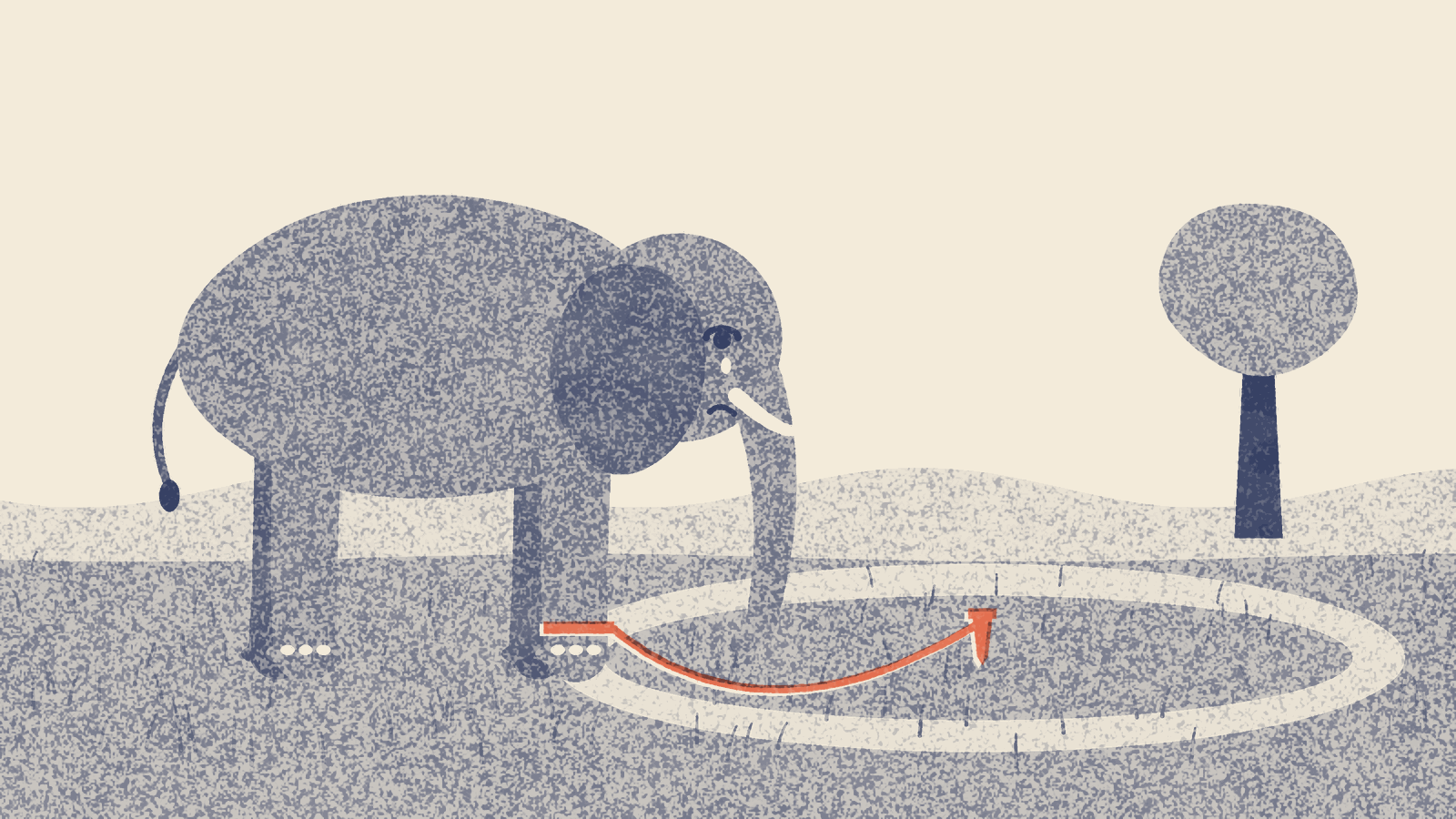
You have sent the application, the apology, the proposal, the request for a raise. Nothing changed, and after enough rounds of this you stop sending. The silence that follows can look like laziness or low ambition from the outside, and it feels like tiredness from the inside. Psychologists have a name for one version of this quiet, and the question of what is learned helplessness has a more interesting answer today than it did fifty years ago.
Key Takeaways
- Learned helplessness is the passive failure to act that follows exposure to events a person or animal cannot control, first documented in dogs by Seligman and Maier in 1967 (Seligman & Maier, 1967).
- In the original experiments, dogs that could end a shock by pressing a panel later learned to escape normally, while dogs given inescapable shock showed strong interference with later escape learning (Seligman & Maier, 1967).
- Hiroto (1974) tested a human version of the experiment with a loud tone in place of shock, with participants grouped by locus of control (Hiroto, 1974).
- A 2016 review by the original authors concluded that passivity in response to prolonged shock is the default, unlearned response, and that what animals learn is control (Maier & Seligman, 2016).
- Maier and Seligman describe the implications for treating depression as speculation, and the step from animal findings to human hopelessness is still open (Maier & Seligman, 2016).
What is learned helplessness, in plain terms
Learned helplessness is a pattern in which repeated exposure to events you cannot influence is followed by passivity, even when a way out later becomes available. The term comes from animal research in the 1960s. Martin Seligman and Steven Maier were studying how animals respond to unpleasant events, and an unexpected result sent them down a path that shaped psychology for decades.
The name carries a claim: that helplessness is learned. For about fifty years that claim defined the theory. We will come back to how it changed, because the revision is the most useful part of the story for anyone living with a stuck feeling.
The 1967 experiment, told plainly
In the experiment reported by Seligman and Maier (1967), dogs were held in a harness with a panel they could press. Some dogs first learned to stop the shock by pressing the panel. Other dogs received inescapable shock in the harness, where nothing they did made any difference.
Afterward, the dogs were placed in a shuttle box, where moving to the other side ended the shock. The dogs that had first learned to press a panel learned escape normally in the shuttle box. The dogs that had received inescapable shock showed strong interference with that later learning (Seligman & Maier, 1967).
What differed between the groups was whether the dogs could do anything about the first shocks, and that difference went with which dogs went on to act and which did not.
The human version
Researchers then asked whether people show something similar. In Hiroto’s (1974) experiment, the aversive event was a loud tone. Participants went through a learned helplessness procedure, and Hiroto also grouped them by locus of control, the degree to which a person expects outcomes to come from their own actions or from outside forces.
The design combined several pretreatment conditions, two sets of instructions and the two locus of control groups. The question it asked was whether a person’s expectations about control shape how much uncontrollability interferes with later effort.
The study measured performance on a laboratory task after a short pretreatment. It is one early test of whether the animal findings carry over to people, and its conditions were far narrower than everyday life.
The 2016 revision: control is what gets learned
Fifty years after the original work, Maier and Seligman published Learned helplessness at fifty, a review of what neuroscience had found in the meantime. Their abstract is direct about the result: the mechanism is now well charted biologically, and “the original theory got it backward.”
Their account runs like this. Passivity in response to prolonged aversive events is the default, unlearned reaction. It is mediated by serotonergic activity in a brain region called the dorsal raphe nucleus, which inhibits escape. That passivity can be overcome when an animal learns control, through activity in the medial prefrontal cortex, which detects control and automatically inhibits the dorsal raphe nucleus (Maier & Seligman, 2016).
Put plainly, the thing that is learned is that events can be controlled. Passivity is where the system rests when no control has been detected.
This moves the interesting question to a new place: what does it take for a person to detect that their actions matter, and how does that detection get built?
What this can mean in everyday life
The research was done on animals and in short laboratory sessions, so the careful reading is that it offers a lens for noticing patterns. Through that lens, a few everyday patterns look familiar:
- A job where decisions are made far above you and your suggestions disappear.
- A relationship in which every attempt to repair things lands the same way, whatever you try.
- A long string of rejections after which the next application feels pointless.
- A goal you have started and abandoned so many times that starting again feels like a joke you already know the end of.
In each, the repeated experience is that effort and outcome seem disconnected. The 2016 account suggests the passive response may be the baseline state the nervous system falls back on, and that experiences of control are what move a person out of it.
Self-sabotage often grows in this soil. If you have wondered what self-sabotage is, the examples in examples of self-sabotaging behavior include procrastination, quitting early and avoiding visible risks, and each of them can follow a stretch in which effort led nowhere. Why people self-sabotage has many answers, and a learned sense of no control is one thread worth following.
Rebuilding the sense that your actions matter
If detecting control is what lifts passivity, then small, real experiences of control are the practical material. Albert Bandura’s work on self-efficacy describes the belief that you can carry out the behaviors a situation requires, and his 1977 paper names performance accomplishments, meaning what you have actually done and seen succeed, as one of four sources of that belief (Bandura, 1977).
That points toward actions with visible, quick results. Some options:
- Pick a task small enough that finishing it is certain, and finish it. Notice that you did.
- Choose one area where your input has a clear, immediate effect, such as a meal, a walk route, or a drawer you can organize.
- Write down what you did and what happened as a result, so the connection between action and outcome sits on the page where you can see it.
- Raise the difficulty a little each time, so that success stays likely and the evidence keeps accumulating.
These steps are modest. They give your mind repeated, concrete evidence that effort produces results, and the 2016 account describes that kind of evidence as what the system responds to. For more on turning this into a plan, how to stop self-sabotaging lays out practices that build on the same idea.
Where the research stops, and where a professional comes in
Maier and Seligman’s closing speculation is that default passivity and the detection and expectation of control may have substantial implications for how to treat depression. The word they use is speculate, and the link between their animal findings and human hopelessness is still an open question. If low motivation, heaviness or loss of interest has been with you for weeks, a doctor or licensed therapist can look at the whole picture with you, and reaching out is a reasonable step to take for yourself.
A question to carry with you
Somewhere in your life there is probably a place where you stopped trying a while ago. Your life holds far more variables than a harness or a shuttle box, which leaves room for the answer to be different from what it feels like now.
It may be worth asking where, in that place, your actions last changed something you could see. And what small, real action might change something you can see this week?
Related reading
- ADHD and Self-Sabotage
- Am I Self-Sabotaging My Relationship?
- Anxious Attachment Style: What It Is, Where It Comes From, and How It Feels in Love
References
Bandura, A. (1977). Self-efficacy: Toward a unifying theory of behavioral change. Psychological Review, 84(2), 191-215.
Hiroto, D. S. (1974). Locus of control and learned helplessness. Journal of Experimental Psychology, 102(2), 187-193.
Maier, S. F., & Seligman, M. E. P. (2016). Learned helplessness at fifty: Insights from neuroscience. Psychological Review, 123(4), 349-367.
Seligman, M. E. P., & Maier, S. F. (1967). Failure to escape traumatic shock. Journal of Experimental Psychology, 74(1), 1-9.